
NFL Weather and Betting: How Wind, Rain and Cold Affect Lines
 Available in US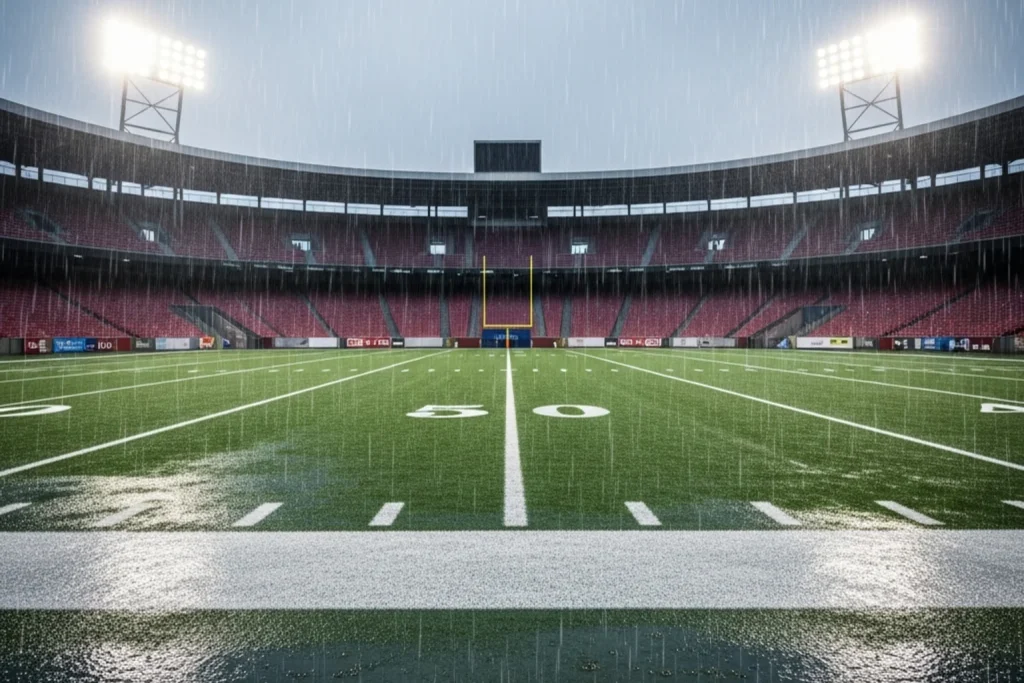
December 2023, a Saturday game in Buffalo. I had the over at 43.5 and felt brilliant about it — both offences had been averaging 26-plus points per game. Then I checked the forecast an hour before kickoff: sustained winds of 28 miles per hour with gusts above 40. The game finished 13-10. My over was dead by halftime, and the quarterback for the visiting side completed barely half his passes because every throw beyond ten yards turned into a knuckleball. That was the day I stopped treating weather as background noise and started treating it as a primary variable — one that moves my projections by more points than any injury short of a starting quarterback going down.
Weather affects NFL outcomes in ways that are measurable, repeatable, and frequently underpriced by the market. Wind suppresses passing games. Rain increases turnovers. Extreme cold tightens up offences. And dome teams travelling to outdoor stadiums in winter face a transitional disadvantage the line rarely captures in full. For UK punters, who follow the NFL primarily through screens rather than stadium seats, weather is easy to overlook — and that neglect is exactly what creates the edge.
See also NFL prop bets for more scorer markets.
Contents
Wind: The Most Underpriced Weather Variable
I have a rule I never break: if sustained winds at kickoff exceed 20 miles per hour, I will not take the over on any game. That rule has saved me more money than any single analytical framework I use. Wind is the most powerful weather variable in the NFL because it directly suppresses the element most responsible for scoring — the forward pass.
NFL quarterbacks throw the ball between 30 and 45 times per game in modern offences. Each of those throws is a projectile affected by air resistance and crosswind deflection. At wind speeds above 15 miles per hour, deep-ball accuracy drops measurably. Completion rates on passes travelling 20 or more air yards decline by roughly 8 to 12 percentage points compared to calm conditions. At 25-plus miles per hour, the deep passing game effectively disappears — coaches adjust play-calling to screens, short routes, and the running game, all of which produce fewer yards per play and fewer scoring drives.
The market adjusts totals for wind, but in my experience the adjustment is consistently insufficient. A game that opens at 46.5 in calm conditions might move to 43.5 when a wind forecast emerges. My models suggest the true adjustment should be closer to five or six points for winds above 20 miles per hour, not three. That gap is where value lives on the under.
Wind also affects field goal accuracy, which matters for both totals and spread betting. Kickers attempting field goals into a headwind lose distance and accuracy, while crosswinds make anything beyond 45 yards unreliable. In games with heavy wind, I expect fewer field goal attempts and more fourth-down conversion tries, which alters the scoring distribution in ways that standard models do not capture. A team that normally attempts three field goals per game might attempt one or none in 25-mile-per-hour gusts, shifting the scoring profile toward an all-or-nothing pattern — touchdowns or punts, with little in between.
Rain, Snow and Surface Conditions
A Monday Night Football game a few years back was played in a downpour so heavy the yard lines were barely visible by the third quarter. There were five fumbles, three interceptions, and neither team scored more than 17 points. I had no position on the game, but I watched it with my notebook open, cataloguing every turnover and every slip at the line of scrimmage. The patterns I recorded that night became the foundation for my rain-game model, and it has been one of my more reliable tools since.
Rain affects NFL games through two mechanisms. First, ball security. A wet football is harder to grip, throw accurately, and catch. Fumble rates increase by roughly 15 to 20 percent in heavy rain compared to dry conditions. Interception rates also rise, partly because quarterbacks compensate for the wet ball by altering their release, and partly because receivers struggle with contested catches. Second, footing. Wet grass surfaces (as opposed to artificial turf) reduce a player’s ability to cut, accelerate, and change direction — disadvantaging speed-based offences more than power-based ones.
Snow is rarer but more dramatic. Heavy snowfall can reduce visibility, bury yard markers, and transform the game into a ground-and-pound affair regardless of either team’s normal play style. The NFL’s most famous snow games have produced wildly unpredictable scores, and the bookmaker knows this — snow-game totals are set conservatively. The value in snow games tends to sit on specific matchup angles rather than blanket over/under plays. A team with a dominant rushing attack facing a defence that struggles against the run gains an amplified advantage in snow, because the passing game equaliser is largely removed. That matchup-specific edge is where I focus in snow forecasts, rather than blindly betting the under.
Surface type matters independently of weather. The NFL’s 30 stadiums split roughly evenly between grass and artificial turf. Grass surfaces degrade as the season progresses, particularly in northern cities where autumn rain and winter freeze-thaw cycles chew up the pitch. By December, the grass at certain stadiums is a muddy mess that slows down skill players and makes footing treacherous. Turf surfaces remain consistent year-round. When a fast, finesse-based offence travels to a degraded grass field, the totals market sometimes fails to account for the surface-speed mismatch.
Cold Weather and the Dome-to-Outdoor Transition
People assume cold weather crushes NFL scoring. The data tells a more nuanced story. Temperature alone — even extreme cold — does not suppress scoring as dramatically as wind or rain. Games played in sub-zero wind chill still routinely produce 40-plus combined points when the air is calm. The cold affects player comfort and ball hardness (a cold football is slightly less grippy), but NFL athletes at this level are conditioned to perform in temperature extremes, and coaching staffs prepare accordingly with heated benches, hand warmers, and adjusted equipment.
Where cold becomes a meaningful betting factor is in combination with wind or precipitation. A 10-degree Fahrenheit game with 20-mile-per-hour winds is categorically different from a 10-degree game in still air. The wind chill amplifies the effects on ball handling, and the cold compounds the grip issues that wind creates independently. I model temperature as a multiplier on wind and rain effects rather than as a standalone variable, and that approach has tracked game outcomes more accurately than treating cold as its own category.
The dome-to-outdoor transition is a separate and underexploited angle. Teams that play their home games in a climate-controlled dome — Dallas, Las Vegas, Atlanta, New Orleans, Houston, Arizona, Detroit, Indianapolis, Minnesota — spend the majority of their season practising and playing in comfortable conditions. When they travel to an outdoor stadium in December or January, the adjustment is significant. These teams are not accustomed to wind affecting their passing game, cold affecting ball security, or precipitation altering footing. The NFL generates roughly 1.2 million UK search queries per month during the season, and a meaningful portion of those searches involve playoff-contending dome teams who look dominant at home but face a hostile outdoor environment in the postseason. The market discounts the dome-to-outdoor transition, and I add 1 to 1.5 points to the outdoor team’s side in those matchups as a baseline adjustment.
See also nfl sport betting for the complete NFL betting guide.
Integrating Weather Into Your Betting Process
Weather should enter your analysis on Thursday at the earliest. Earlier in the week, forecasts are too unreliable to act on — a projected storm system on Tuesday may have moved or dissipated by game day. I check forecasts on Thursday for a directional read, then confirm on Saturday morning for final bet decisions. The key data points I record are sustained wind speed at kickoff, precipitation type and probability, temperature at kickoff, and the specific stadium’s exposure profile (open-air, partial dome, full dome, retractable roof).
Not all outdoor stadiums are equally exposed to weather. Chicago’s Soldier Field is fully open and sits on the Lake Michigan shoreline, where wind gusts amplify off the water. Green Bay’s Lambeau Field is open but partially sheltered by the stands. Buffalo’s Highmark Stadium is notorious for lake-effect snow. Kansas City’s GEHA Field at Arrowhead is open but sits in a region where extreme cold arrives earlier than in the Northeast. Each venue has a specific weather profile that I factor into my projections, and over time I have built a stadium-by-stadium adjustment table that captures these differences.
The practical workflow looks like this. I set my projected spread and total for each game using team data alone. Then I apply weather adjustments based on the Saturday forecast. Wind above 15 mph reduces my projected total by two to four points depending on intensity. Heavy rain reduces it by one to two points and shifts my spread slightly toward the team with the stronger running game. Snow of more than two inches triggers a larger reduction and a stronger lean toward ground-based offences. Dome-to-outdoor transitions add points to the outdoor side. These adjustments stack — a dome team travelling to a windy, rainy outdoor stadium faces the full combined effect.
After adjusting, I compare my new numbers to the listed lines. If the bookmaker’s total has not moved enough to account for the weather, the under becomes a bet. If the spread has not reflected a dome team’s outdoor disadvantage, the home side becomes a bet. The edge is not in predicting weather — anyone can read a forecast. The edge is in quantifying its impact more accurately than the market does.
Weather-Proofing Your Season-Long Strategy
The first twelve weeks of the NFL season are played in broadly temperate conditions across most of the country. Weather becomes a dominant factor only in Weeks 13 through 18 and the playoffs, when northern stadiums experience their harshest conditions. This seasonal pattern means your weather-adjusted betting model is dormant for the first two-thirds of the season and active for the final third — which happens to coincide with the most consequential games and the heaviest betting volume.
I keep a weather log for every outdoor game I bet during the season. After the season ends, I review the log to assess how accurately my weather adjustments predicted the scoring impact. Over three seasons of tracking, I have refined my wind model twice and my rain model once based on this feedback. The adjustments were small — half a point here, a percentage tweak there — but they compounded into a measurably better performance in weather-affected games.
One final point: weather creates variance, and variance is the enemy of undisciplined staking. A weather-affected game can produce a 6-3 final or a freak 42-38 shootout in snow. The under hits more often in bad weather, but the misses can be spectacular. I account for this by reducing my stake size slightly on weather-dependent bets — typically to 75 percent of my standard unit. The reduced stake reflects the higher uncertainty while still allowing me to capitalise on the systematic edge that weather provides. For a broader staking framework that accounts for varying confidence levels across different bet types, the bankroll management guide lays out a tiered approach that integrates naturally with weather-adjusted betting.
