
NFL Sport Betting in the UK: Data-Driven Guide for 2026
 Available in US
Odds, strategies, betting types, London games, and regulatory landscape backed by data.

Introduction to NFL Sport Betting in the UK
I placed my first NFL wager on a Sunday afternoon in 2015, sitting in a Shoreditch flat with a laptop balanced on my knee and no real idea what a point spread was. The Kansas City Chiefs were playing — I remember that much — and the fractional odds staring back at me from the screen might as well have been written in hieroglyphics. I lost seven quid. But something clicked that day: the American game, with its stop-start rhythm and constant statistical output, felt purpose-built for betting in a way no other sport quite matches. Eleven years later, that hunch has turned into a career.
NFL sport betting in the UK has shifted from a fringe curiosity to a genuine market force. The numbers tell the story better than I ever could. The sport now commands 15 million fans across Britain — a figure that has grown by nearly two million since 2019. Across the Atlantic, legal wagers on the 2025 NFL season reached an estimated billion, an 8.5% jump year-on-year. And the broader UK gambling industry generated a gross gambling yield of GBP 16.8 billion in the twelve months to March 2025, growing 7.3% against the prior year. NFL betting sits at the intersection of those three trendlines: a swelling British fanbase, explosive American handle growth, and a mature domestic gambling market that keeps expanding.
15 Million
NFL fans in the United Kingdom, including over 100,000 young flag football participants
Billion
Estimated legal wagers on the 2025 NFL season across the United States
GBP 16.8 Billion
UK gambling industry gross gambling yield for April 2024 to March 2025
This guide is built differently from the affiliate roundups you will find elsewhere. I am not here to rank bookmakers or push sign-up offers. My interest is in the data, the mechanics, and the edges — the analytical side of NFL wagering that the UK market has largely ignored. Whether you are placing your first NFL wager or your five-hundredth, the goal is the same: sharper, better-informed decisions every time you open a betslip.
What Every UK Punter Needs to Know Before Kickoff
- The UK sports betting market is projected to reach .3 billion by 2030, and NFL is one of its fastest-growing verticals — driven by 15 million British fans and expanded broadcast deals on Sky Sports and Channel 5.
- Remote Gaming Duty nearly doubles from 21% to 40% in April 2026, which will tighten odds margins and reduce promotional offers across every operator.
- Fractional odds remain the UK default, but understanding decimal and American formats unlocks sharper line-shopping and better value identification.
- London games, with 42+ fixtures since 2007, offer genuine analytical edges around jet lag, travel fatigue, and neutral-venue dynamics that most bookmakers underprice.
- Responsible bankroll management is non-negotiable: 60% of industry profits come from just 5% of customers at risk of gambling harm.
Why the NFL Has Become a Serious Betting Sport in Britain
A mate of mine who runs a small independent bookshop in Leeds told me last autumn that he sold more NFL merchandise than cricket gear for the first time ever. Anecdotal, sure — but it mirrors something I have tracked across a decade of data: American football is no longer a novelty in the UK. It is an established part of the sporting calendar, and the betting market reflects that.
The NFL counts 15 million fans in Britain. Henry Hodgson, the league's General Manager for the UK and Ireland, put it plainly when discussing the 2025 London schedule: the league is focused on serving those fans year-round, not just during the handful of international games. That shift in tone — from promotional spectacle to sustained engagement — tells you everything about where this sport sits culturally. London gets multiple regular-season fixtures each autumn. Sky Sports and Channel 5 broadcast games across the weekend. Fantasy leagues run in offices from Edinburgh to Exeter. The infrastructure for fandom, and by extension for betting, is already here.
The NFL attracts roughly 1.2 million search queries per month in the UK — about 13% of the volume generated by the Premier League. For a sport that did not register on the national radar twenty years ago, that is a remarkable footprint.
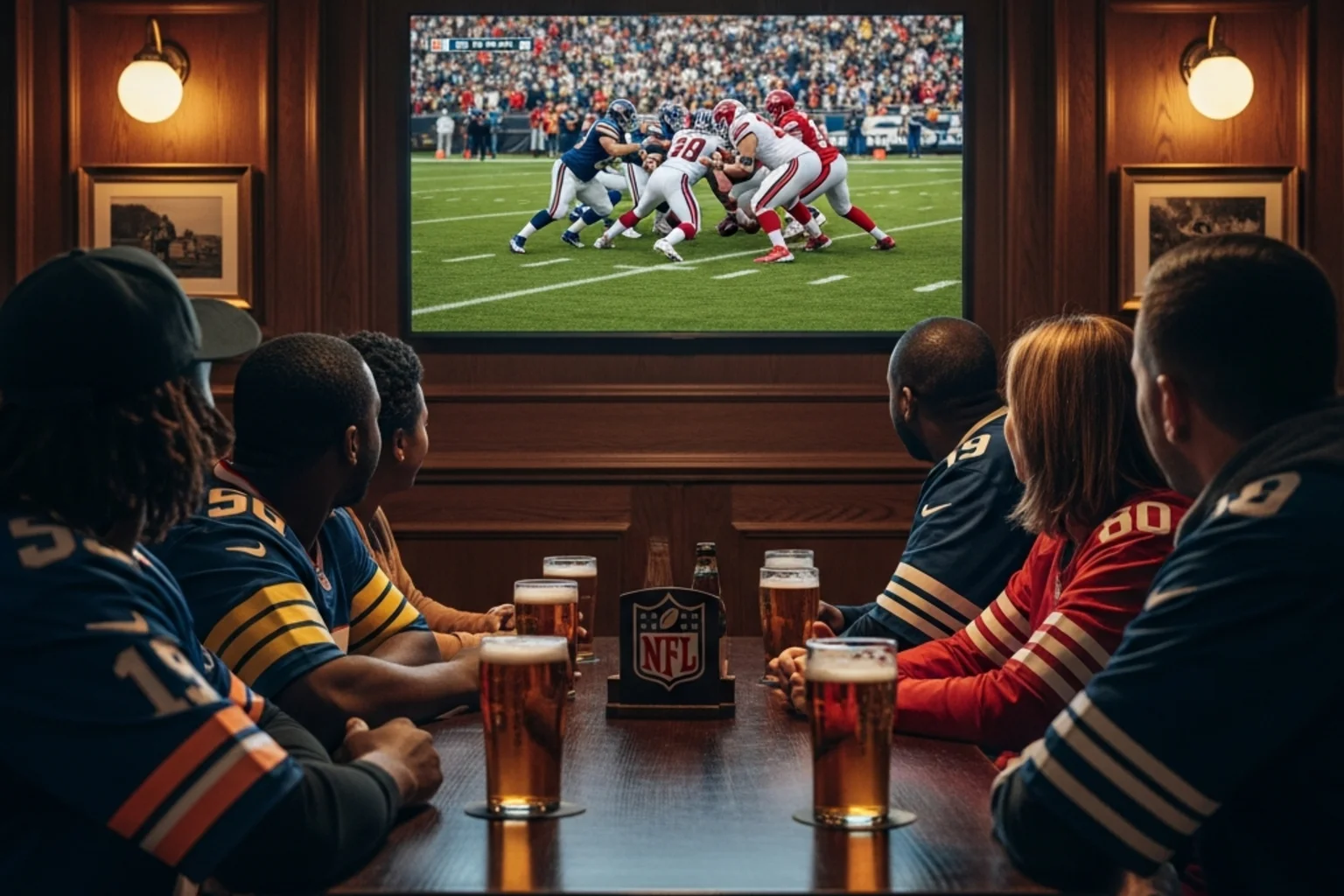
The most searched NFL team in Britain is Kansas City Chiefs, pulling approximately 50,000 monthly queries. The Taylor Swift effect, the back-to-back Super Bowl runs, and consistent primetime scheduling have made them the de facto gateway team for new UK fans — and, by extension, for new UK bettors.
What matters for punters is what this fanbase creates downstream: deeper markets, tighter odds, more promotional focus from operators, and better broadcast access. A decade ago, placing an NFL wager in Britain meant trusting a scoreline you would not see until the next morning. Now you can watch live on free-to-air television and adjust your in-play positions in real time. That accessibility has turned NFL sport betting from a specialist pursuit into something any engaged sports fan can do well.
The UK Betting Market in Numbers — and Where NFL Fits
I keep a spreadsheet of every Gambling Commission report I have read since 2017. It is a deeply boring document, and I love it. The numbers in that spreadsheet paint one of the clearest pictures in all of sports finance: the UK gambling market is enormous, it is growing, and the remote sector — online and mobile — is the engine pulling everything forward.
GBP 16.8 Billion
Total industry gross gambling yield, April 2024 to March 2025 — up 7.3% year-on-year
GBP 7.8 Billion
Remote casino, betting and bingo GGY in the same period — up 13.1% year-on-year
.3 Billion
Projected UK sports betting revenue by 2030, reflecting 11.4% compound annual growth
That GBP 7.8 billion remote-sector figure is the one I circle every year. It grew at nearly double the rate of the broader industry, and it represents the environment in which virtually all NFL betting takes place. You are not walking into a William Hill shop to bet on the Buffalo Bills at 1:30 in the morning. You are doing it on your phone, from bed, with one eye on a Sky Sports stream. The remote sector's 13.1% growth rate tells you that more people are doing exactly that, across more sports, more frequently.
Roughly 10% of the UK adult population participates in online sports betting. That translates to around 290 million online wagers placed on real-world events every single month — a volume that sustains deep liquidity even in markets far less popular than football or horse racing. NFL benefits from that liquidity. When millions of bets flow through British platforms every month, operators have both the incentive and the data infrastructure to offer comprehensive NFL coverage: pregame lines, in-play markets, player props, futures, and same-game parlays that would have been unthinkable a decade ago.
The growth trajectory matters too. Research projections place the UK sports betting market at .3 billion in revenue by 2030, growing at an 11.4% compound annual rate. That growth will not be distributed evenly across sports. The Premier League will always dominate, horse racing will hold its ground, but the marginal gains — the incremental billions — will flow toward sports with expanding fanbases and broadcast deals. NFL ticks both boxes. A massive and growing domestic fanbase, the multi-year Sky Sports contract, the Channel 5 free-to-air partnership: these are the structural conditions that make NFL one of the fastest-growing betting verticals in British sport.
What to Look for in an NFL Bookmaker — Without the Sales Pitch
Every other guide on this topic hands you a numbered list of operators and tells you which one is "best." I find that approach useless because "best" depends entirely on what you are trying to do. A casual punter chasing accumulator insurance needs a different platform from someone grinding through a 17-game slate looking for price edges. So instead of ranking names, here are the criteria that actually matter.
The UK market is dominated by a handful of large operators. Flutter Entertainment posted group revenue of .91 billion in 2025 — a 17% year-on-year increase. In paid search advertising for sports betting, one legacy brand commanded 37.83% of all clicks in February 2026, with the next largest at 16.2%. That concentration means the big operators set the baseline for NFL coverage. But baseline is not everything. For a deeper look at how platforms stack up, I have written a dedicated breakdown of NFL betting sites available to UK punters.
| Criterion | What to Check | Why It Matters for NFL |
|---|---|---|
| Odds margin | Compare moneyline and spread prices across three or four platforms for the same game | NFL margins vary more between operators than you might expect — a 1-2% edge compounds over a full season |
| Market depth | Count the number of individual markets offered for a standard Sunday game | Prop bets, alternate spreads, and team totals are where informed bettors find value |
| Bet builder availability | Test whether same-game combinations are offered for NFL, not just Premier League | Some platforms restrict their bet builder to domestic sports |
| In-play speed | Place a live bet during a Thursday Night Football game and note the delay | NFL drives move fast — a sluggish in-play interface costs real money |
| Cash-out terms | Read the fine print on partial cash-out and suspended-market rules | NFL games swing wildly; flexible cash-out matters more here than in low-scoring sports |
The table above is not a ranking. It is a framework. Use it to test any operator you are considering, and you will make a more informed choice than any "Top 5" listicle could provide.
Three Odds Formats, One Price — How to Read NFL Lines in the UK
The single biggest source of confusion I see among UK punters new to NFL betting is not the sport itself — it is the odds. You are accustomed to fractional odds on horse racing and Premier League accumulators. Then you open an NFL market and find decimal odds, or worse, American odds with plus and minus signs that seem designed to intimidate. The truth is simpler than it looks: all three formats express the same underlying probability. Once you see that, the fog lifts.
Fractional odds — the traditional British format, shown as a ratio like 5/2 or 11/4. The first number is the profit you stand to make, the second is the stake required. A winning bet at 5/2 returns GBP 5 profit for every GBP 2 wagered, plus your original stake back.
Decimal odds — popular across Europe and the default on many UK platforms. Shown as a single number like 3.50 or 1.91. Multiply your stake by the decimal to get your total return, including the original stake. A GBP 10 bet at 3.50 returns GBP 35.
American odds — the native format in the US, shown with a plus or minus sign. Positive odds like +250 tell you the profit on a GBP 100 stake. Negative odds like -110 tell you how much you must stake to profit GBP 100. You will encounter these on US-sourced analysis, podcasts, and line-tracking sites.
I switch between formats depending on what I am doing. Decimal is fastest for comparing prices across bookmakers because it is a single number — higher means better value, no mental arithmetic needed. Fractional is useful for accumulators because UK platforms multiply fractional odds neatly when building multiples. American is what I read when consuming US-based analysis, which is where the sharpest NFL content lives.
| Format | Odds | GBP 10 Stake | Total Return | Profit |
|---|---|---|---|---|
| Fractional | 5/2 | GBP 10 | GBP 35 | GBP 25 |
| Decimal | 3.50 | GBP 10 | GBP 35 | GBP 25 |
| American | +250 | GBP 10 | GBP 35 | GBP 25 |
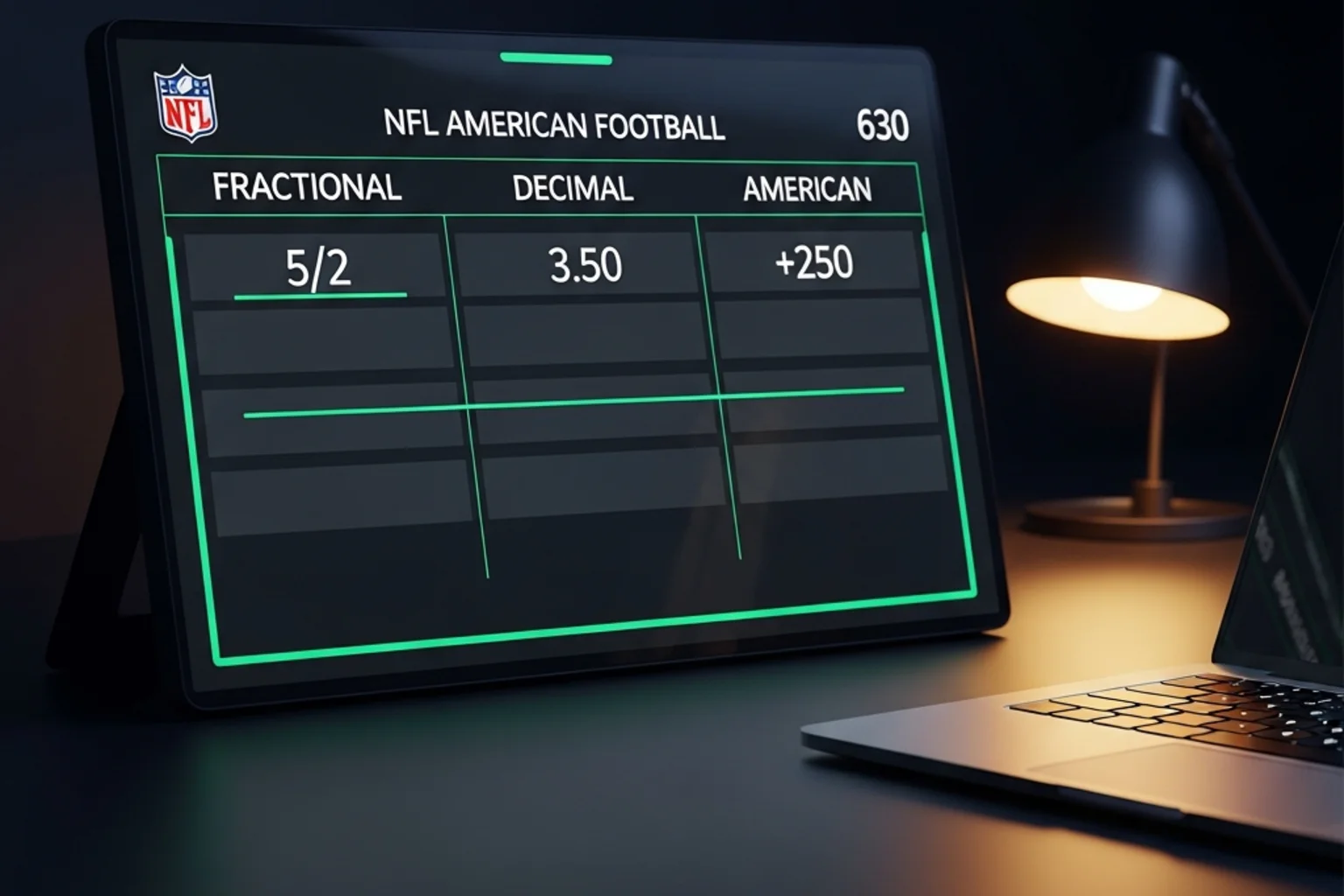
All three rows in that table describe exactly the same bet, the same payout, and the same implied probability of 28.6%. The format is cosmetic. What matters is whether 28.6% accurately reflects the real probability of the outcome. That question leads you into line shopping, implied probability analysis, and value identification, all of which I cover in my full breakdown of NFL betting odds.
One practical tip: most UK platforms let you toggle between fractional and decimal in your account settings. Set it to decimal for price comparisons. Fractional odds make 11/8 and 6/4 look wildly different; decimal shows them as 2.375 and 2.50, and the comparison is instant.
Every NFL Bet Type You Can Place in Britain — A Working Map
When I started covering NFL betting for a UK audience, I noticed something odd: most guides either listed two or three bet types and moved on, or they dumped twenty market names with no context for which ones a British punter would actually encounter. What you need is a working map — an understanding of how each market functions and where it fits into a broader approach. For full mechanical detail on each one, see my separate guide to NFL betting types and markets.
Moneyline — the simplest NFL wager. You pick the team you believe will win the game outright. No spread, no points, just the result. Moneyline odds on heavy favourites can be short enough to feel unrewarding, which is why this market is most useful for underdogs or evenly matched contests.
Point spread — the signature NFL betting market. The bookmaker assigns a handicap to level the playing field. A team favoured by 6.5 points must win by 7 or more for a spread bet to pay out. This is the market that generates the most handle in American football and the one around which most analysis is built.
Totals (over/under) — a wager on the combined score of both teams. The bookmaker sets a line — say, 47.5 — and you bet on whether the actual total lands above or below that number. Totals are less dependent on picking a winner and more dependent on understanding the pace and efficiency of both offences and defences.
Props (player and game) — proposition bets on specific events within a game. Will a particular quarterback throw over 275.5 passing yards? Will there be a safety? Player props have exploded in popularity because they let you bet on individual performances rather than game outcomes, turning every snap into a potential market.
Futures — long-range wagers placed weeks or months before the outcome is decided. Super Bowl winner, conference champions, MVP awards, season win totals. Futures tie up your stake for an extended period, but they also offer the highest potential returns and the most room for informed bettors to find mispriced lines before the public catches up.
Beyond these five pillars, you will encounter parlays (known as accumulators in the UK), teasers that let you adjust spreads in your favour at reduced odds, and same-game parlays — the bet-builder format that combines multiple selections from a single fixture into one wager. Each of these layered markets adds complexity and, crucially, adds margin for the bookmaker. That does not make them bad bets; it makes them bets that require a clearer edge to justify. The strategic question is not "which market is best?" but "which market gives me the clearest informational advantage on this specific game?" If you have studied a team's red-zone efficiency all week, a touchdown scorer prop might be your sharpest angle. If you have noticed a line moving against the public, the spread is your territory.
Data Over Gut Feeling — What Actually Works in NFL Wagering
Here is the most expensive lesson I have learned in ten years of NFL betting: I used to trust my eye test more than the numbers, and it cost me roughly GBP 3,000 before I changed course. I would watch a team look dominant on a Monday night, convince myself they were a lock the following week, and bet accordingly — ignoring the schedule, the injury report, and the closing line. The numbers do not care about feelings. That is what makes them useful.
The NFL generated billion in legal American wagers during the 2025 season. Bill Miller, the president of the American Gaming Association, noted that legal sports betting enhances the engagement that makes NFL traditions special — and the handle figures prove the scale of participation. When you are betting into a market with that much liquidity, casual analysis is not enough.
Do
- Track your closing line value — it is the single most reliable predictor of long-term profitability in NFL betting, more so than win rate
- Factor situational variables into every bet: bye weeks, short weeks, divisional rivalry games, cross-country travel, dome-to-outdoor transitions
- Set a fixed unit size and a seasonal bankroll before Week 1 — then stick to it regardless of results
- Shop lines across at least three platforms; a half-point difference on a spread changes your expected value meaningfully over a full season
Don't
- Chase losses by increasing your stake after a bad week — variance in a 17-game season is brutal and normal
- Bet on every game because "it's Sunday and the slate is full" — selectivity is a strategic advantage, not a sign of indecision
- Treat parlays as a primary strategy; the compounded margin works against you with every added leg
- Ignore line movement — when a spread moves a full point between Tuesday and kickoff, there is a reason, and it is rarely random
A single section cannot make you a sharp bettor. What it can do is point you toward the concepts that separate profitable NFL bettors from the rest: closing line value, situational handicapping, bankroll discipline, and market efficiency. Each deserves a deep dive, and I have written exactly that in my guide to NFL betting strategies.
The single best habit you can develop is tracking whether you consistently beat the closing line — the final odds at kickoff. If you do, you are finding value. If you do not, no amount of "good reads" will save your bankroll over a full season.
In-Play NFL Betting — Why It Hits Different at 2am
There is a particular kind of focus that kicks in when you are watching a fourth-quarter drive at half past one in the morning, your live bet hanging on whether the offence converts a third-and-seven. The house is silent, the broadcast is American, and every play feels like it takes three times longer than it should. In-play NFL betting is not for everyone, but for those of us who enjoy it, there is nothing else quite like it in the British betting calendar.
The mechanics are straightforward: once a game kicks off, the bookmaker continually adjusts the odds in response to what is happening on the pitch. Scores, turnovers, injuries, momentum shifts — all of it feeds into the live line. You can bet on the next scoring play, the result of the current drive, updated spreads and totals, or player props that recalculate in real time. Mobile platforms handle the bulk of this activity; across the US market, where in-play infrastructure is most advanced, more than 80% of all legal wagers are placed via mobile devices. The UK pattern is similar.
NFL in-play betting differs from football or tennis in one critical way: the game clock stops constantly. Commercial breaks, timeouts, the two-minute warning, challenges — these pauses give you time to think, evaluate, and act. It is a slower live-betting rhythm than you are used to, and that is an advantage if you use the dead time to reassess rather than impulse-bet.
The challenge for UK punters is timing. A standard 1pm ET Sunday kickoff translates to 6pm GMT — manageable. But Sunday Night Football does not kick off until 1:20am Monday in Britain. If you are betting in-play on late games, fatigue becomes a genuine factor for your decision-making and, interestingly, for the players on the field. I have found that late-window games tend to see less sharp money from UK and European markets, which can create softer lines for anyone disciplined enough to stay awake.
For a thorough look at in-play markets and quarter-by-quarter tactics, see my dedicated piece on NFL live betting for UK punters. If you are going to bet in-play, do it with a plan — not because you are bored at midnight and the game is on.
London Games and the Betting Lines Nobody Talks About
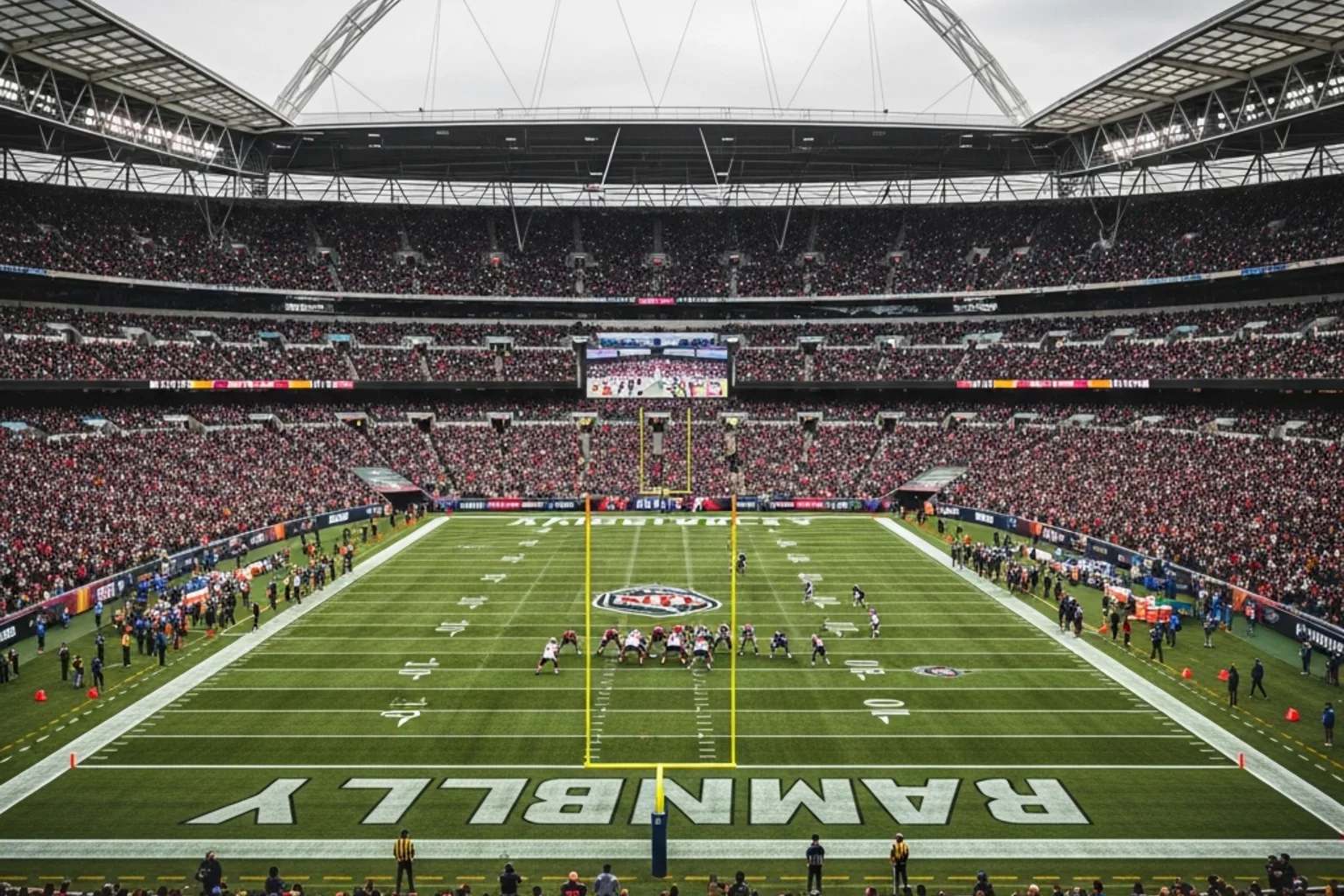
I was at Wembley for the 2025 game that drew 86,651 fans — a record attendance for an NFL regular-season fixture in London. The atmosphere was genuinely electric, the kind of thing you remember years later. But what I remember most is checking the spread on my phone as I walked to the stadium and thinking: this line is wrong. The bookmaker had not adequately priced in the travel disadvantage for the team flying in from the Pacific time zone, and the final result proved it. London games are a goldmine for bettors who pay attention to the details that the market often overlooks.
The NFL has staged more than 42 regular-season games in London since 2007. That sample is now large enough to identify genuine patterns in scoring, covering, and how jet lag interacts with game-week preparation — yet most UK-focused guides treat these fixtures as novelty events rather than analytical opportunities.
Three factors make London games uniquely interesting from a wagering perspective. First, jet lag. A team based on the US East Coast loses five hours flying to London; a West Coast team loses eight. Research from other sports — and a growing body of NFL-specific data — shows that the team with the greater time-zone disruption tends to underperform relative to its regular-season baseline. This is not a guaranteed edge, but it is a measurable one that the market does not always fully incorporate into the spread.
Second, the neutral-venue effect. London games strip away traditional home-field advantage. Neither team has a home crowd in the conventional sense, even if one is technically designated as the "home" side. The crowd at Wembley or Tottenham Hotspur Stadium tends to support whichever team is more popular in the UK, which is not always the designated home team. That neutrality changes the calculus for bettors who rely on home-field advantage data.
Henry Hodgson has described the London programme as a catalyst for year-round fan engagement. The league's international strategy is no longer experimental; it is a core revenue driver that the NFL expects to expand. For bettors, more London fixtures means more data and a growing edge for anyone tracking the patterns seriously.
Third, scheduling context. Teams playing in London often have a bye week immediately after, which affects how coaches manage their game plans. Some franchises treat the London trip seriously; others approach it with visible reluctance. That variation in preparation quality shows up in the box score more often than the market seems to recognise.
Watching the Games You Bet On — UK Broadcast Access in 2026
I cannot count the number of times someone has asked me: "Can I actually watch NFL games in Britain, or am I just staring at a score ticker?" The answer has improved dramatically in recent years. The UK now has the most comprehensive NFL broadcast package of any country outside the United States, and understanding what is available — and when — directly affects your ability to bet effectively.
Sky Sports signed a new three-year contract with the NFL that delivers roughly 50% more live games than the previous deal. Every European fixture, the key primetime windows, and extensive RedZone coverage are included. Jonathan Licht, Sky's Chief Sports Officer for the UK and Ireland, credited record-breaking Super Bowl viewership as evidence of the sport's growing grip on British audiences.
The bigger development for casual fans is the Channel 5 partnership. As the official free-to-air NFL broadcaster in Britain, Channel 5 shows two games every Sunday during the regular season — typically at 6pm and 9pm — along with all London games and the Super Bowl. You do not need a Sky subscription to watch NFL. That sentence would have been unthinkable five years ago, and it changes the betting equation significantly. Access to live coverage means access to live data: formations, injury updates, momentum swings, weather conditions. All of it feeds into smarter in-play decisions.
The audience is responding. Super Bowl LVIII drew 3.4 million unique viewers on British television, making it the most-watched NFL broadcast in UK history. That is not a niche audience. That is a primetime event competing with domestic football for eyeballs — and for betting slips.
For UK punters, the practical broadcast schedule breaks down like this: Sunday early window at 6pm GMT, late window at 9:25pm GMT, Sunday Night Football at 1:20am Monday GMT, Monday Night Football at 1:15am Tuesday GMT, and Thursday Night Football at 1:20am Friday GMT. London games kick off at 2:30pm or 6pm local time — the most civilised slots on the schedule. If you plan your betting week around broadcast access, Sundays and London weeks are where your edge is highest because you can watch and bet simultaneously.
Regulatory Shifts Every UK NFL Bettor Needs to Understand
Most betting guides treat regulation as a box-ticking exercise: "Make sure your bookmaker has a UKGC licence." That approach was forgivable a few years ago. It is not now. The regulatory landscape for UK online betting is undergoing its most significant transformation in a decade, and the changes directly affect your experience as an NFL punter — from deposit thresholds to promotional emails to the margins built into every price.
The Remote Gaming Duty — the tax operators pay on their UK revenue — is jumping from 21% to 40% from 1 April 2026. A new 25% rate on remote betting follows from April 2027. This is the single largest fiscal change in UK gambling history, and it will ripple through every aspect of the industry: odds margins, promotional generosity, and market depth.
When an operator's tax burden nearly doubles, the money has to come from somewhere. It comes from tighter odds — wider margins baked into every line. It comes from fewer and smaller promotional offers, because the economics of bonusing customers no longer work at previous levels. And it comes from reduced investment in niche sports coverage, because operators will concentrate resources on the highest-volume markets. NFL, as a growing but still secondary sport in the UK, sits right on the edge of that prioritisation line. Andrew Rhodes, the CEO of the UK Gambling Commission, has signalled that the regulatory environment will only tighten further, describing emerging risks like crypto-gambling as an 18-months-to-two-years challenge rather than a distant concern.
Since 28 February 2025, operators must conduct financial vulnerability checks when a customer's net deposits reach GBP 150 or more within a rolling 30-day period. These checks are automated and can temporarily restrict your ability to deposit or bet. If you are an active NFL bettor placing wagers across a full Sunday slate, you will likely hit that threshold within the first few weeks of the season.

There is also a marketing dimension. From 1 May 2025, direct marketing from gambling operators requires granular opt-in consent — specific permission broken down by product type and communication channel. For NFL bettors, this means fewer promotional offers unless you actively opt in to NFL-specific marketing, which many punters neglect because the opt-in process is buried in account settings.
The expected tax revenue increase from gambling is projected to reach GBP 810 million in 2026/27, scaling to GBP 1.16 billion by 2030/31. That money flows from operator margins to the Treasury. The odds you see on your screen in the 2026 NFL season will be structurally worse than the odds you saw in 2024, and the reason is regulatory, not market-driven.
Protecting Yourself When the Sunday Slate Gets Addictive
I need to be honest about something. There was a stretch during the 2019 season when I was betting on every single game, every single week — sometimes stacking player props and live bets on top. My bankroll was eroding, my sleep was wrecked, and I was telling myself it was "research." It was not. I pulled back, set hard limits, and rebuilt my approach from scratch. That experience is why I take this section seriously.
The data on gambling harm in the UK is sobering. According to the House of Lords Gambling Industry Committee, 60% of the industry's profits come from just 5% of customers — those who are either problem gamblers or at serious risk of becoming one. That statistic should sit uncomfortably with anyone who participates in this market, including me. It means the commercial model depends disproportionately on people who are being harmed by it.
GAMSTOP is the UK's national self-exclusion scheme. Registering blocks you from all UKGC-licensed online gambling sites for six months, one year, or five years. It is free and immediate. If you suspect your betting has crossed the line from entertainment to compulsion, this is the most effective single step you can take.
Beyond GAMSTOP, every licensed operator must offer deposit limits (daily, weekly, monthly), loss limits, session time reminders, and cooling-off periods. These tools only work if you use them. I set a weekly deposit limit at the start of every NFL season and do not adjust it mid-season, regardless of results. That constraint removes the most dangerous decision point: the moment you consider depositing more after a bad Sunday.
Before You Place Any NFL Bet
- Confirm your weekly deposit limit is set and active in your account settings
- Check that you are betting with money you can genuinely afford to lose — not bill money, not savings, not borrowed funds
- Ask yourself whether you are betting because you have identified an edge, or because the game is on and you want to make it more exciting
- Review your recent betting history: if you have increased your stakes after losses in the past fortnight, pause and reassess
- Ensure you have at least one full day per week with no active wagers — a rest day for your decision-making as much as your bankroll
None of this makes me a less serious bettor. If anything, it makes me a more profitable one. The punters I know who have sustained long-term success in NFL betting all share one trait: they treat bankroll protection with the same rigour they apply to handicapping games. The two disciplines are inseparable.
Mapping the NFL Betting Year — From Draft Night to the Final Whistle
One of the things that surprised me most when I started taking NFL betting seriously was how much action happens outside the regular season. The American football calendar is not a six-month affair that starts in September and ends in February. For bettors, it runs year-round — and each phase offers different markets, different edges, and different risk profiles.
The cycle begins in late April with the NFL Draft. Futures markets open months before the event: first overall pick, first quarterback selected, positional picks by round, and over/under on draft position for specific players. These markets attract relatively thin liquidity, which means prices can be inefficient. If you follow the college football scouting process closely — and I realise that is a niche within a niche for UK audiences — draft betting offers some of the softest lines in the entire NFL calendar.
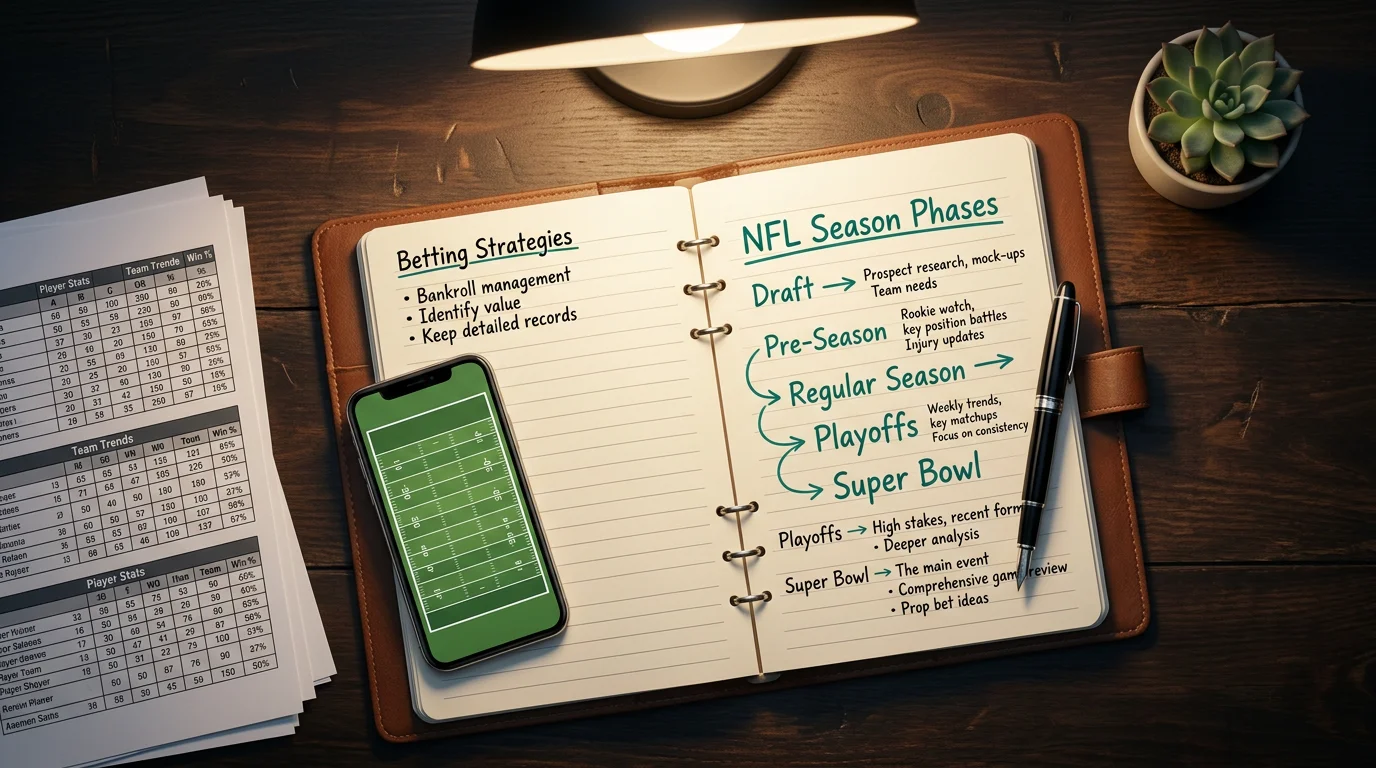
Summer brings pre-season games, which have limited betting appeal because starters play sparingly. But this is the window when season-long futures — Super Bowl winner, conference champions, division winners, season win totals — are at their most volatile. Information asymmetry peaks: coaching staffs know their rosters better than the market does, injuries are still emerging, and the public has not yet coalesced around consensus views. I place the majority of my futures bets during this July-to-August window.
The regular season runs from early September through early January: 17 games per team, spread across 18 weeks. Lines open on Sunday evening for the following week, move through Tuesday and Wednesday as injury reports emerge, and sharpen toward kickoff. Understanding that weekly rhythm is essential for timing your bets. January and February bring the playoffs and the Super Bowl — the single most heavily wagered sporting event on the planet. The expected handle for Super Bowl LX was .76 billion at legal American sportsbooks alone. Playoff betting is a different discipline: smaller sample sizes, higher stakes, and more public money distorting the lines.
Then the cycle resets. Free agency in March, the Draft in April, and the futures markets open again. If you treat NFL betting as a seasonal hobby that starts in September, you are missing half the calendar and arguably the half with the softest markets.
With the full calendar mapped and the market mechanics covered, the remaining questions tend to be practical ones — the kind of things you type into a search bar at midnight. The FAQ below addresses the most common queries I receive from UK punters approaching NFL betting for the first time or returning after a break.
Common Questions About NFL Sport Betting in the UK
Is NFL betting legal in the UK?
Yes, fully legal. Any bookmaker holding a licence from the UK Gambling Commission can offer NFL markets to British customers. The UKGC regulates all remote gambling operators serving the UK market, including those offering American football. You are not operating in a grey area — NFL betting sits within the same legal framework as Premier League or horse racing betting. The key requirement is that the operator is UKGC-licensed; offshore or unlicensed platforms are illegal for UK residents to use and carry zero consumer protection.
What are the best NFL betting sites for UK punters?
That depends on what you prioritise. If odds margins matter most, compare moneyline and spread prices across three or four UKGC-licensed platforms for the same game. If market depth is your priority, test how many individual markets a platform offers for a standard Sunday fixture — props, alternate spreads, team totals. If you rely on in-play betting, test the speed of the live interface during a Thursday Night Football game. There is no universal "best" — only the best fit for your approach. I avoid recommending individual brands because the landscape shifts constantly; what matters is applying the right evaluation criteria.
How do NFL point spreads work?
A point spread is a handicap applied to one team to create a theoretically even contest. If a team is favoured by 6.5 points, they must win by 7 or more for a bet on them to pay out. Conversely, a bet on the underdog at +6.5 wins if that team loses by 6 or fewer — or wins outright. The half-point eliminates the possibility of a push (a tie against the spread). Spreads are the most popular NFL betting market worldwide because they equalise mismatches and create a roughly 50/50 proposition on almost every game, which in turn creates the sharpest, most liquid market for analysis.
What types of NFL bets can I place in the UK?
UK bookmakers offer the full spectrum of NFL markets: moneyline (picking the outright winner), point spreads (handicap betting), totals (over/under on combined scores), player and game props (individual statistical outcomes), futures (Super Bowl winner, MVP, season win totals), accumulators (parlays combining multiple selections), teasers (adjusted spreads at reduced odds), and same-game parlays (bet builders combining selections from a single fixture). The depth of coverage varies by operator and by the prominence of the game — a Sunday Night Football fixture will have more markets than a Thursday game between struggling teams.
Do NFL bets include overtime?
For most standard wagers at UK bookmakers — moneyline, point spread, and totals — yes, overtime counts. The final result including any overtime period determines whether your bet wins or loses. The exception is prop bets tied to specific quarters or halves, which settle on the regulation-time result for that segment only. Some operators also offer "regulation time" totals as a separate market, which explicitly excludes overtime. Always check the individual market rules on your platform, because settlement terms can vary between operators and between bet types within the same operator.
What time do NFL games start in the UK?
Standard Sunday kickoffs translate to 6pm GMT for the early window and 9:25pm GMT for the late window. Sunday Night Football kicks off at 1:20am Monday GMT. Monday Night Football starts at 1:15am Tuesday GMT, and Thursday Night Football begins at 1:20am Friday GMT. London games, when scheduled, kick off at 2:30pm or 6pm local UK time. These times shift by one hour during British Summer Time (late March to late October), so an early Sunday game becomes 6pm BST rather than 6pm GMT. The Channel 5 free-to-air broadcast typically covers the 6pm and 9pm windows on Sundays.
Can I bet on NFL games live / in-play?
Yes, and it is one of the most engaging aspects of NFL sport betting. Most major UK bookmakers offer in-play markets throughout every televised NFL game: updated spreads and totals, next scoring play, drive result, and player props that recalculate after each snap. The staccato rhythm of American football — with its constant clock stoppages, commercial breaks, and timeouts — makes NFL uniquely suited to live betting because you have more thinking time between markets than in continuous-play sports like football or tennis. The main constraint for UK punters is the late kickoff times for primetime games, which test your endurance as much as your analysis.
