
Best NFL Betting Sites UK: Ranked by Odds and Features
 Available in US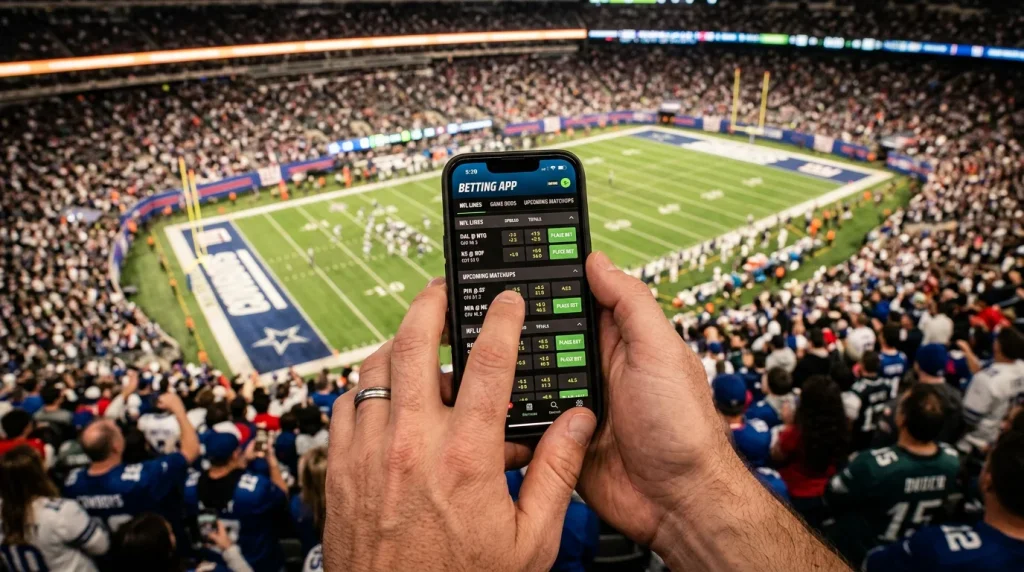
I spent the better part of last September bouncing between six different sportsbook accounts, placing identical NFL moneyline bets on Week 1 games, just to see how much the payouts varied. The difference on a single Kansas City Chiefs match was over 4% between the best and worst price I found. On a 50-quid stake, that gap looks trivial. Multiply it across a full 18-week season of regular bets, and you’re talking about hundreds of pounds left on the table — or pocketed, depending on where you chose to play.
That experiment crystallised something I’d suspected for years: the bookmaker you use matters far more than most punters realise. The UK market is saturated with operators chasing your first deposit, and NFL coverage has become a genuine battleground. William Hill commands nearly 38% of paid search clicks in the sports betting category, while bet365 sits at around 16% — but market share in advertising tells you nothing about which platform actually delivers the best experience for American football wagering.
With Flutter Entertainment’s group revenue hitting $15.91 billion in 2026 — a 17% year-on-year surge — the big operators have the cash to invest in NFL product. The question is whether they’re spending it on slicker marketing or on genuinely better odds, deeper markets, and faster live feeds. I’ve spent the past ten years dissecting exactly that question, and what follows is my working framework for separating the signal from the noise when choosing where to bet on the NFL in the UK.
See also NFL betting apps for mobile access to top sites.
Contents
How I Rank NFL Betting Sites
Every “best of” list in this niche reads like it was drafted by the affiliate team — and honestly, most of them were. I wanted a different approach, one rooted in measurable criteria rather than whoever pays the fattest commission this quarter. So here’s how my ranking actually works, and I’d encourage you to steal the method for your own comparisons.
The single most important factor is odds margin, sometimes called overround or vig. This is the bookmaker’s built-in profit on every market, and it directly determines how much value you get back. A typical NFL moneyline market at a UK sportsbook carries an overround between 4% and 7%. That range sounds narrow until you realise a 3-percentage-point difference in margin, compounded across a season, is the difference between a profitable year and a losing one for a disciplined bettor. I calculate margin on at least twenty NFL games per operator before drawing conclusions — a single market snapshot is meaningless.
Second is market depth. Not every bookmaker covers NFL with the same enthusiasm. Some offer moneyline, spread, and totals on primetime games and little else. Others run full player prop sheets, drive results, quarter lines, and anytime touchdown scorer markets for every fixture on the Sunday slate. If you’re serious about NFL wagering, shallow market coverage kills your ability to find edges.
Third: bet builder functionality. The ability to combine correlated selections within a single game — say, a quarterback passing over 250 yards and his team winning by more than 3 points — has become a core feature of modern NFL betting. But the quality of bet builders varies enormously. Some platforms restrict leg counts, block certain combinations, or quietly widen margins inside the builder. I test these manually, pricing out equivalent straight bets and comparing the combined return.
Beyond those three pillars, I look at live betting latency (how fast in-play odds update relative to the broadcast), cash-out flexibility, mobile app stability during peak Sunday traffic, and the transparency of promotional terms. Licensing under the UK Gambling Commission is a baseline requirement, not a differentiator — every operator I evaluate holds a valid UKGC licence.
What I deliberately exclude: welcome bonus size. A fat free bet means nothing if the platform bleeds you 2% extra on every wager for the next five years. I’m playing the long game, and so should you.
UK Bookmakers With the Strongest NFL Coverage
Let me tell you about the night I tried to place a same-game parlay on a Thursday Night Football match at 1:15am, only to discover two of my five accounts had suspended their NFL bet builder markets because it was past midnight UK time. That’s the kind of operational detail no review site ever mentions — and it matters enormously if you’re a night-owl punter following the late-window games.
Rather than handing you a numbered podium, I’ll walk through the attributes that separate the serious NFL operators from the ones merely ticking a box. The landscape shifts every season as operators renegotiate data feeds and retool their platforms, so I focus on structural advantages that tend to persist.
The operators with the deepest NFL roots in the UK market tend to share a few characteristics. They maintain dedicated American football trading desks — not a single trader bolted onto a football-heavy team, but specialists who understand the nuances of snap counts, pace-adjusted DVOA, and the difference between a meaningless Week 17 game and a divisional playoff. You can tell which operators have this because their prop lines are tighter, their markets open earlier in the week (often by Tuesday), and they price alt spreads in half-point increments rather than full points.
Coverage breadth is the next giveaway. During a standard NFL Sunday, you’ll have up to 14 games kicking off across two windows. The best UK sportsbooks price every game across moneyline, spread, totals, first-half lines, player props (passing, rushing, receiving yards and touchdowns), team props, and drive-level markets. Weaker operators might cover the primetime games fully but offer only three-way markets on the early-window fixtures. I keep a running tally across the season, and the gap is consistent: the strongest platforms carry 80 to 120 individual markets per game, while the weakest hover around 20 to 30.
Then there’s the data pipeline. Genius Sports holds exclusive official NFL data rights through a deal worth $120 million that runs until Super Bowl 2030. Every licensed UK bookmaker receiving this feed can offer real-time in-play markets with high accuracy. But the way they integrate that data into their live product — the speed of odds updates, the variety of in-play props, the frequency of market suspensions during reviews — varies wildly. I’ve timed the lag between an on-field event and the corresponding odds update across multiple platforms, and the fastest operators react within two to three seconds. The slowest take eight or more, which is an eternity if you’re trying to act on a momentum shift.
A practical test you can run yourself: open three or four sportsbook apps side by side during a Sunday afternoon game. Place them all on the same match and watch how quickly each updates after a scoring play. Within a few weeks, you’ll have a clear picture of which platforms genuinely invest in their NFL live product and which are running on autopilot. The operators whose margins I’ve consistently found to be sharpest on NFL also tend to be the ones with the fastest live feeds — that correlation isn’t coincidental. Tight pre-game pricing and responsive live markets both stem from the same cause: a well-resourced trading operation that treats American football as a first-tier sport, not a sideshow to Premier League weekends.
One more structural point worth noting. The paid search data from early 2026 shows William Hill capturing close to 38% of PPC clicks in the UK sports betting space, with bet365 at roughly 16%. That tells you about advertising spend, not product quality. Some of the operators with the smallest marketing footprints run the tightest NFL odds because they don’t need to recoup enormous acquisition costs through wider margins. Don’t confuse visibility with value.
Odds Margins: Where Your Money Goes Further
Here’s a number most punters never calculate: the percentage of every pound you stake that the bookmaker keeps before the match even kicks off. That’s the margin, and it’s the single biggest determinant of your long-term returns. I’ve tracked NFL margins at UK sportsbooks for seven consecutive seasons now, and the patterns are remarkably stable year to year.
For a standard two-way NFL market — moneyline on a competitive matchup — the overround at major UK operators typically falls between 4.0% and 6.5%. To put that in context, the equivalent margin on a Premier League match at the same bookmaker is often 2.5% to 4.0%. NFL punters in the UK are systematically paying more vig than football bettors at the same shop, and most don’t even realise it. The reason is simple economics: NFL sees less volume in the UK, so operators widen margins to protect themselves against sharper action in a thinner market.
Point spread markets tend to carry slightly lower margins than moneylines, because the balanced nature of spread betting (roughly equal action on both sides) reduces the bookmaker’s risk exposure. If you’re choosing between backing a favourite on the moneyline at -250 or laying the 6.5-point spread at -110, the spread almost always offers better value per unit of risk. I’ve run the maths on hundreds of games, and the spread edge is consistent enough that I now default to it for any game where I like the favourite.
Totals (over/under) markets sit somewhere in between — margins typically range from 4.5% to 5.5% at the sharper operators. Player prop markets are where the margins really balloon, sometimes exceeding 8% or even 10%. That’s the cost of the complexity: props require more sophisticated modelling, and operators protect themselves by widening the spread between the over and under prices. It doesn’t mean props are unprofitable — just that you need a bigger edge to overcome the higher tax.
The practical takeaway? Hold accounts at a minimum of three operators and line-shop every bet. The 30 seconds it takes to check a second or third price will save you more money over a season than any welcome bonus or odds boost promotion. I can’t stress this enough — if you take one thing from this entire article, make it this habit.
A quick method for calculating margin yourself: convert each side of a two-way market to implied probability (divide 1 by the decimal odds), add them together, and subtract 1. The result is the overround expressed as a decimal. A market priced at 1.91 / 1.91 gives you (1/1.91 + 1/1.91) – 1 = 0.0471, or a 4.71% margin. Once you start doing this routinely, you develop an instinctive sense for when you’re getting a fair price and when you’re being squeezed.
Bet Builders and NFL-Specific Features
I’ll admit something: bet builders nearly ruined my bankroll management in 2022. The appeal of stacking four or five correlated legs into a single NFL bet at juicy combined odds is genuinely intoxicating. It took a brutal 0-for-12 losing streak on same-game parlays to force me back to first principles — and that process taught me more about how bet builders actually work under the hood than any amount of casual use ever would.
The core mechanic is straightforward: you combine multiple selections from the same game into a single wager. A typical NFL bet builder might include the match winner, over/under total points, a player to score a touchdown, and a quarterback to throw for over 250 yards. The platform calculates combined odds, and all legs must win for the bet to pay out.
What’s less obvious is how those combined odds are calculated. Most operators don’t simply multiply the individual prices. They apply correlation adjustments — sometimes transparently, often not. If you pick a team to win and their star running back to score a touchdown, those outcomes are positively correlated. A truly fair price would reflect that correlation. In practice, some platforms adjust accurately while others use the correlation as cover to quietly widen margins. I’ve compared bet builder prices against manually calculated fair odds on dozens of combinations, and the hidden markup ranges from 5% to as high as 20% depending on the operator and the specific legs involved.
The NFL-specific features worth paying attention to are pre-built SGP templates (same-game parlay templates that group popular combinations), drive result markets (will the current drive end in a touchdown, field goal, punt, or turnover), and alt line flexibility. Alt lines let you adjust the spread or total in exchange for modified odds — for instance, buying an extra 3 points on a spread at reduced juice. The best platforms offer alt spreads in half-point increments from -0.5 all the way to -20.5, giving you precise control over risk and reward.
One feature that separates the serious NFL operators from the pack is early market availability. Some platforms open their NFL bet builders by Tuesday or Wednesday, when early lines are posted. Others don’t activate them until Friday or even Saturday. If you’ve done your research mid-week and want to lock in a position before the lines move, early builder access matters. I’ve found value disappears faster each season as the NFL betting market matures in the UK — getting in early is increasingly the only way to capture soft opening lines.
If you want a deeper dive into the mechanics and pitfalls of combining legs, I’ve written a separate breakdown on how same-game parlays work at British bookmakers that covers the correlation maths in more detail.
Welcome Offers and NFL Promotions
Every September, like clockwork, my inbox used to fill with NFL-themed welcome offers — free bets, deposit matches, enhanced odds on the season opener. I say “used to” because the regulatory landscape shifted hard in May 2026. Direct marketing from gambling operators now requires granular opt-in consent, broken down by product type and communication channel. If you haven’t actively opted in to receive NFL betting promotions via email, text, or push notification, you won’t see them. The days of carpet-bombing new customers with unsolicited bonus offers are over.
That regulatory change is worth understanding because it affects how you discover and access promotions. The offers themselves haven’t vanished — operators still compete aggressively for new accounts — but the delivery mechanism has fundamentally changed. You’ll now find most NFL-specific promotions inside the app or website itself, rather than in your email. This means you need to actively check the promotions tab at each operator during the NFL season rather than waiting for offers to come to you.
As Bill Miller, the head of the American Gaming Association, put it when discussing how fans engage with the sport: legal sports betting enhances the fun and the friendly competition that make NFL games and traditions special. That sentiment drives the promotional strategy — operators frame NFL offers as entertainment enhancers rather than financial incentives, partly to stay on the right side of UK advertising standards.
Now, about the offers themselves. The most common NFL promotions in the UK market fall into a few categories. Welcome free bets typically range from 10 to 40 pounds and come with wagering requirements or minimum odds conditions. Weekly odds boosts on primetime NFL games — Thursday Night, Sunday Night, Monday Night — are nearly universal during the season. Accumulator insurance, where you get a refund (usually as a free bet) if one leg of a multi-leg NFL bet lets you down, is offered by most major operators for accas of four legs or more. And Super Bowl specials, which ramp up dramatically in January and February, often represent the most generous promotional window of the NFL calendar.
My approach to promotions is pragmatic: I claim them when the terms are favourable but never let a bonus dictate my betting behaviour. A free bet with 5x wagering requirements on odds of 1.50 or higher has a calculable expected value, and it’s usually positive — but only if you use it on a bet you’d place anyway. The moment you start forcing bets to meet promotional conditions, you’ve already lost the value the promotion was supposed to deliver.
Betting on NFL From Your Phone
Over 80% of all legal sports bets in the US are placed via mobile. The UK figure isn’t far behind, and for NFL specifically — a sport where games kick off at inconvenient hours for British punters — mobile is arguably even more dominant. I’ve placed NFL bets from the back of a taxi at 1am, from the sofa at halftime of a Sunday night game, and once, memorably, from a train that kept dropping signal between Birmingham and London. That last experience taught me which apps hold up under patchy connectivity and which ones crash and burn.
The qualities that matter for NFL mobile betting are slightly different from general sports betting. Speed during live games is paramount — when you’re watching a drive unfold on Sky Sports and want to take a live line, a two-second delay in the app loading the bet slip is the difference between getting your price and seeing “odds have changed.” App stability during peak NFL traffic is another crucial factor. Sunday afternoons between 6pm and 9pm UK time, when the early and late US windows overlap, are the heaviest traffic period for NFL betting in the UK. Lightweight apps with efficient data handling survive this window; bloated ones stutter.
Push notifications for NFL line movements are a feature I now consider essential. The best apps let you set alerts on specific games or markets — tell me when the Chiefs spread moves past -3, for example — and deliver them reliably. Others offer blanket notifications that are more noise than signal.
One practical tip from years of late-night NFL mobile betting: download and test the app before the season starts. Create your account, verify your identity, deposit funds, and place a small test bet. I cannot count the number of messages I’ve received from readers who tried to open a new account at 1am on Week 1 Sunday, hit an identity verification delay, and missed the game entirely. The verification process at UK-licensed operators is mandated by the UKGC and can take anywhere from minutes to 72 hours depending on the checks required. Do it in August, not September.
Deposits, Withdrawals and Financial Checks
This is the section nobody wants to read but everybody needs to. Since February 2026, UK gambling operators must run financial vulnerability checks when a customer’s net deposits reach 150 pounds or more within a rolling 30-day period. That threshold is lower than most people expect, and it triggers a process that can temporarily restrict your account while the operator reviews your financial circumstances.
The checks aren’t arbitrary — they’re mandated by the Gambling Commission’s Licence Conditions and Codes of Practice, and they exist to prevent financial harm. But for a regular NFL bettor depositing modest amounts across multiple game weeks, hitting that 150-pound trigger is almost inevitable. Here’s how it works in practice: you deposit 50 pounds in Week 1, another 50 in Week 2, and 60 in Week 3. You’ve crossed the threshold. The operator may ask for documentation (bank statements, payslips) or run a soft credit-style check. The experience varies between operators — some handle it seamlessly in the background, others send alarming-looking emails that make you feel like you’re applying for a mortgage.
My advice is to treat this as a feature, not a bug. The checks are a genuine consumer protection, and operators who implement them smoothly and transparently are, in my view, better run than those who make the process painful. If a platform handles your vulnerability check with clear communication and minimal friction, that tells you something about their operational standards across the board.
On the deposit side, most UK operators accept debit cards (credit cards were banned for gambling in April 2020), bank transfers, PayPal, Apple Pay, and various e-wallets. Minimum deposits typically start at 5 to 10 pounds. Withdrawal times depend on method: e-wallets are usually within 24 hours, debit cards take 1 to 3 business days, and bank transfers can stretch to 5 days. A few operators now offer instant withdrawals via certain payment methods, which is a genuine quality-of-life improvement when you want to move profits quickly.
One nuance specific to NFL bettors: if you’re using multiple accounts for line-shopping (which you absolutely should be), your deposits are spread across platforms. That means you might hit the 150-pound threshold at multiple operators simultaneously around Weeks 3 to 4 of the season. Budget your opening deposits with this timing in mind, and have any requested documentation ready to upload digitally. Nothing derails a promising start to the NFL season like having your account frozen because you couldn’t locate a payslip on your phone at midnight.
See also nfl sport betting for the complete NFL betting guide.
Picking the Right Platform for Your NFL Season
Every punter I’ve spoken to who stuck with a single operator for an entire NFL season ended up leaving money on the table. The margins are too variable, the promotional calendars too different, and the market depth too uneven across platforms for any single account to cover all your needs. My recommendation — earned through ten years of tracking this sport in the UK market — is to maintain at least three active accounts, funded and verified before the opening kickoff. Use the sharpest odds for straight bets, the best bet builder for same-game parlays, and the most generous promotional schedule for occasional enhanced plays. That three-account strategy isn’t complicated, but it’s surprisingly effective.
The UK’s 290 million monthly online bets on real events are placed across a crowded field of operators, and the NFL slice of that pie is growing every year. As the 15 million British NFL fans discover that betting deepens their engagement with the sport, the operators who invest in genuine product quality — tight margins, deep markets, fast live feeds — will earn long-term loyalty. The ones relying on bonus-churn tactics will lose customers to better-run competitors. Your job is to be on the right side of that split, and now you have the framework to make that call.
