
NFL Live Betting Strategy: In-Play Markets and Timing Edges
 Available in US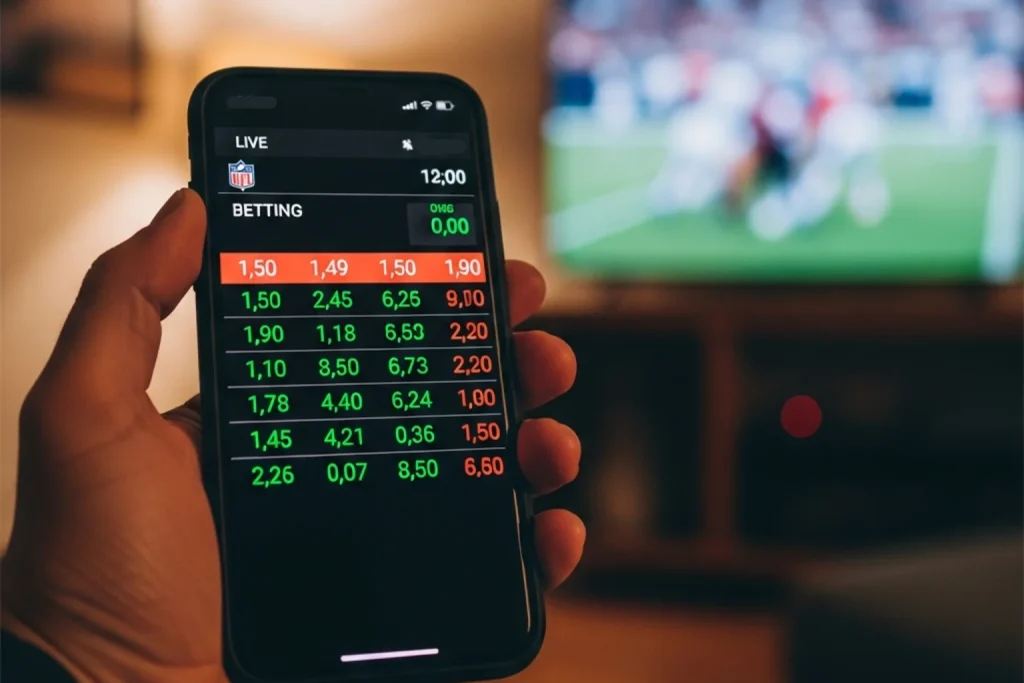
The bet that converted me to live betting came during a Sunday afternoon game where the favoured team fell behind 14-0 in the first quarter on two fluke turnovers. The pre-game spread had been -6.5. By the time the second quarter started, the live spread had flipped to +3.5 for the same team. Their offence had not changed, their defence had not collapsed — two freak plays had temporarily destroyed the market’s confidence. I backed them at +3.5 and they won by ten. That was the moment I realised that live NFL betting is not about reacting faster than everyone else. It is about recognising when the market overreacts and stepping in while the price is wrong.
In-play betting now accounts for a growing share of NFL handle across UK-licensed operators. The appeal is obvious: you can watch the game develop, assess momentum shifts in real time, and place bets with information that was not available before kickoff. The risk is equally obvious — speed, emotion, and the adrenaline of a live contest push punters into impulsive decisions. Profitable live betting requires a specific set of skills and a discipline that pre-game wagering does not demand.
See also NFL broadcast in the UK for viewing options.
Contents
How NFL Live Markets Differ from Pre-Game
I spent my first season of live betting treating it like pre-game with a shorter clock. That was wrong. The structure of in-play markets is fundamentally different, and ignoring those differences cost me money before I understood what I was doing.
Pre-game markets are open for days, absorbing information from injury reports, weather forecasts, and sharp money. By kickoff, the line represents a consensus view shaped by tens of thousands of bets. Live markets do not have that luxury. They update continuously based on algorithms that factor in score, time remaining, possession, down and distance, and field position. These algorithms are good — but they are not perfect. They react to score changes instantly and sometimes excessively, particularly after dramatic plays like interception returns for touchdowns or blocked field goals.
The odds refresh speed varies by operator. Some UK bookmakers suspend live markets during active plays and reopen them between snaps. Others keep markets open continuously but adjust odds dynamically. The practical difference matters: on platforms that suspend during plays, you are betting during stoppages with relatively stable information. On platforms with continuous markets, you are competing against the algorithm’s speed, and the window for value is measured in seconds.
Live markets also carry wider margins than pre-game. Where a pre-game spread might sit at 10/11 on both sides (roughly 4.5 percent margin), live spreads often price at 5/6 or even 4/5 (margins of 7 to 9 percent). The bookmaker charges more for the convenience of betting in real time. This means your edge needs to be larger to overcome the additional cost — a critical point that casual live bettors overlook entirely.
Timing Windows Where Value Appears
Two years of tracking my live bets revealed a clear pattern: nearly all my profit came from bets placed during three specific windows. The rest of my live action — the impulsive bets during exciting moments — was a net loser. Once I restricted my activity to those windows, my results transformed.
The first window opens immediately after a scoring play that changes the live spread by three or more points. When a team returns an interception for a touchdown, the algorithm adjusts the spread dramatically — but these momentum-shifting plays rarely reflect a genuine change in team quality. The defence did not suddenly get worse because the offence turned the ball over. If the turnover was situational (a tipped ball, a miscommunication, a bad bounce), the live spread is temporarily mispriced. I place the majority of my live bets in the 60 to 90 seconds after these plays, before the market corrects.
The second window is halftime. During the break, the live spread resets based on first-half performance, but the market often overweights what just happened and underweights structural factors like second-half adjustments. Teams with strong coaching staffs — historically, sides coached by tacticians who are known for halftime adjustments — tend to outperform their halftime live spread in the second half. This is one of the few live betting angles supported by multi-season data rather than gut feeling.
The third window is the middle of the third quarter, when public interest in live betting peaks and casual money floods in. If one team has dominated the first half, recreational bettors pile onto that side for the second half, pushing the live spread past fair value. Fading that public money — backing the losing team when the spread has moved too far — produces a small but consistent edge over large sample sizes.
See also nfl sport betting for the complete NFL betting guide.
Cash-Out Decisions During Live NFL Games
Every UK betting app now features a cash-out button, and it glows at you with the persistent charm of a slot machine. I have a complicated relationship with that button. Used correctly, it is a powerful risk-management tool. Used emotionally, it is a margin destroyer.
Cash-out offers are calculated by the bookmaker’s algorithm, and they always include the bookmaker’s margin. When you cash out early, you are selling your bet back at a price that benefits the operator. The question is whether that price is acceptable given your current assessment of the game. If you placed a pre-game bet at +7.5 and the team you backed is now leading at halftime, the cash-out offer will be positive — but it will be less than the expected value of holding the bet to completion. You are paying a premium for certainty.
I use cash-out in exactly two scenarios. First, when I have new information that materially changes my assessment — a key player injury during the game, a tactical shift I did not anticipate, or weather conditions that have worsened beyond what the forecast predicted. Second, when the cash-out offer represents more than 80 percent of the potential full payout and the game situation has become genuinely uncertain. Outside those scenarios, I let bets run. The bookmaker’s margin on cash-out makes frequent use a losing strategy over time.
Live Prop Markets and Quarter Betting
Beyond the live spread and total, UK operators now offer real-time prop markets during NFL games — next scoring play, next team to score, drive result, and individual player lines that update possession by possession. These markets are newer, thinner, and less efficiently priced than the main live lines. That combination creates opportunity for punters who understand game flow.
Drive result props are my favourite live market. When a team starts a drive inside its own 10-yard line, the probability of a punt is significantly higher than average, but the market does not always price this correctly in the seconds after the drive begins. Similarly, when a team has first-and-goal inside the five, the touchdown probability is roughly 65 percent — if the market offers odds implying less than that, there is value on the score.
Quarter betting — predicting the highest-scoring quarter or the result of a specific quarter — offers another angle. First quarters tend to be lower-scoring than the market expects because teams are still executing their opening scripts and feeling out the opponent’s defensive scheme. Fourth quarters are higher-scoring when the game is close, due to aggressive play-calling and the two-minute drill. Betting the under on first-quarter totals and the over on fourth-quarter totals in close games has been a quietly profitable approach for me over the past two seasons. For a broader overview of bet types available to UK punters including quarter and half bets, the prop bets guide covers the full landscape.
Discipline as the Defining Edge in Live Betting
The NFL generates roughly 1.2 million search queries per month in the UK alone, and a growing fraction of that interest translates into live wagering on Sundays and Monday nights. The sheer volume of opportunities during a live NFL broadcast — new markets every 30 seconds, odds flickering constantly, the cash-out button pulsing — creates an environment designed to encourage action. Your edge as a live bettor is not speed or insider knowledge. It is the ability to do nothing when nothing is worth betting on.
I keep a strict rule: no more than three live bets per game, and zero live bets if I have not identified a specific scenario I am waiting for before kickoff. Walking into a live game with an open mind sounds enlightened, but in practice it means you are reacting rather than executing a plan. The punters who profit from live NFL betting are the ones who watch 80 percent of the game without touching their app, then strike in the narrow windows where the algorithm has mislaid the odds.
Record every live bet with a timestamp and the specific trigger that prompted it. After a month, review your log. If more than half your bets came during exciting moments rather than at preidentified value windows, you are gambling on adrenaline, not on an edge. That distinction is everything in a market where the bookmaker’s margin is already working against you more aggressively than in any pre-game market.
