
NFL Playoff Betting UK: Postseason Strategy and Market Shifts
 Available in US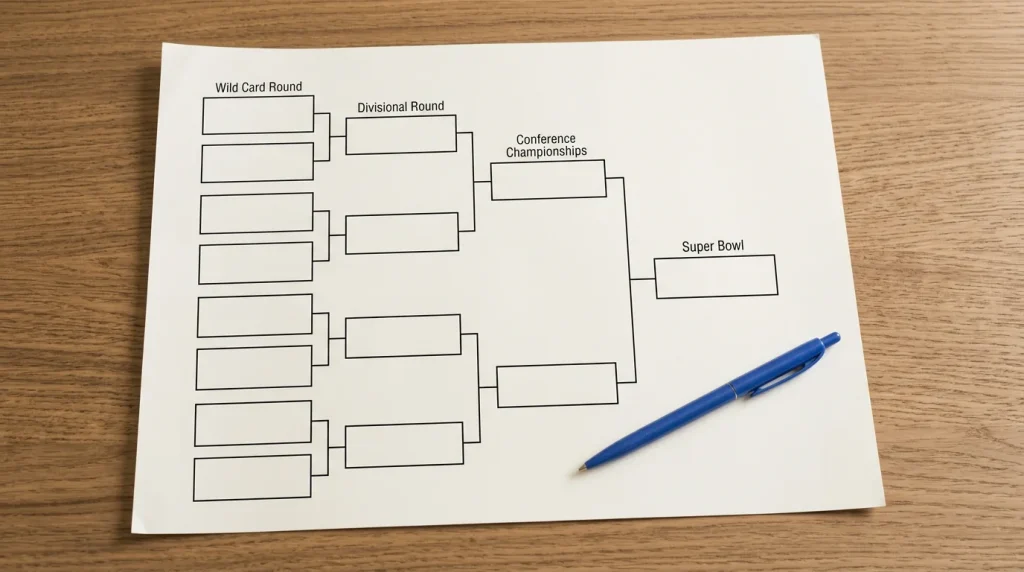
My worst postseason bet and my best postseason bet happened in the same January. The worst: I backed a first-round favourite at -10 because they had demolished teams by similar margins all season. They won by three. The line was set for a regular-season version of that team, not for a playoff opponent with two weeks to prepare a specific defensive scheme. The best: I took a divisional-round underdog at +7.5 after noticing that the closing line value on underdogs in that round had been consistently positive for three consecutive seasons. The underdog lost by four. I cashed. Those two bets crystallised something I now treat as a core principle — playoff football is a structurally different game from the regular season, and your betting approach must shift to match.
The NFL postseason compresses the best 14 teams into a single-elimination tournament across four weekends. From a betting perspective, everything changes: the sample of teams is smaller, preparation time is longer, coaching adjustments are more detailed, and the emotional stakes amplify every decision on and off the field. Regular-season models and tendencies carry over to a point, but the specific dynamics of postseason football create opportunities that only appear in January and February.
See also NFL prop bets for in-game player markets.
Contents
How Playoff Markets Differ from the Regular Season
The regular-season NFL betting market is efficient because of volume — 272 games across 18 weeks give bookmakers and sharp bettors an enormous sample to calibrate their models. The playoff market handles far less volume across far fewer games: 13 total from Wild Card weekend through the Super Bowl. That compression changes the market’s behaviour in ways that create genuine value.
Lines move more aggressively on playoff games. A single piece of news — a quarterback’s injured throwing hand, a defensive coordinator’s gameplan leak, a weather forecast shift — can swing the line by two or more points because the market is thinner and each piece of information carries proportionally more weight. I have seen Wild Card lines move three points between Tuesday and Saturday based on nothing more than a practice report indicating that a star player was limited. In the regular season, that same report moves the line half a point.
Public money concentrates on playoff favourites more than at any other time in the year. Casual bettors who barely touched the NFL during October and November suddenly flood the market in January, and they overwhelmingly back the team they have heard of — which is usually the higher seed. This creates a persistent bias toward favourites in the betting handle that does not always reflect the actual probability gap between the teams. Fading this public bias on selectively chosen underdogs has been one of my most reliable postseason strategies.
Wild Card Weekend: Volume Meets Chaos
Wild Card weekend features six games — the most of any playoff round — and it consistently produces the highest rate of upsets. Lower seeds host their first playoff game of the season against opponents who may be battle-tested veterans of January football or first-time postseason participants. The variance is enormous, and the betting market does not always calibrate for it correctly.
One pattern I track every year is the performance of teams making their first playoff appearance with a new quarterback. These teams tend to be overvalued by the public because of their regular-season record, but underperform in the postseason because the quarterback has no experience reading playoff-calibre defensive schemes that are specifically designed to exploit his weaknesses. A defensive coordinator with two weeks to prepare a game plan against a young quarterback who has never faced that level of scrutiny creates a mismatch that the regular-season record does not capture.
Wild Card unders have also been a reliable lean. The combination of heightened defensive preparation, conservative play-calling in early playoff games, and unfamiliar opponent matchups suppresses scoring relative to regular-season averages. I do not bet the under blindly on every Wild Card game, but when my other signals align — strong defensive teams, poor weather forecast, or quarterbacks with limited postseason experience — I weight the under more heavily in this round than any other.
Divisional Round and Conference Championships
The Divisional Round is the sharpest weekend of football in the NFL calendar. The four remaining games pit top seeds — rested after a first-round bye — against Wild Card winners riding momentum. This creates a fascinating tension that the betting market often resolves too cleanly in favour of the rested team.
Bye-week teams enter the Divisional Round with physical advantages (rest, recovery, game planning time) but a subtle disadvantage: they have not played a competitive game in two to three weeks. That rust is real and measurable. First-half scoring by bye teams in Divisional Round games lags behind their regular-season first-half averages by roughly two points. By the second half, they have shaken off the rust and typically play to form. This first-half underperformance is an edge I exploit through first-half spread bets, backing the Wild Card winner to cover in the first half while taking the full-game line on the bye team if I believe they are the stronger side overall.
Conference Championship games are the purest expression of NFL quality. The final four teams are, by definition, among the best in the league. The spreads are tight — usually between one and four points — and the market is at its most efficient. Value in championship games is scarce, and I reduce my action accordingly. When I do bet this round, it is almost always on a total rather than a side, because the weather and venue effects (outdoor stadiums in January) create the most significant mispricings. The Super Bowl projected handle of $1.76 billion for the most recent edition tells you how much public money is waiting for the title game — but the conference championship weekend, with less hype and more genuine tactical uncertainty, is where I have found more consistent value over the years.
See also nfl sport betting for the complete NFL betting guide.
Super Bowl Betting: Handle, Hype, and Hidden Value
The Super Bowl is the single largest betting event in the world. The sheer volume of money and attention creates a market environment unlike any other game on the NFL calendar. Finding an edge requires understanding where the market is most distorted by the two-week buildup.
The spread market on the Super Bowl is among the most efficient in all of sports. Two weeks of analysis, unlimited media coverage, and massive sharp-money action mean the closing line is extremely accurate. I rarely bet the Super Bowl spread for this reason — the edge I can find on a Tuesday afternoon is almost always arbitraged away by kickoff. Where I focus instead is on the prop markets, which attract disproportionate public money and are priced less rigorously.
Super Bowl player props — touchdown scorers, passing yards, receiving totals — are priced weeks in advance and remain open to bets throughout the two-week lead-up. Public bettors pile into star players and headline narratives, inflating the prices on popular selections while leaving value on secondary players whose roles may increase due to matchup-specific game plans. I do my deepest prop research during Super Bowl week, cross-referencing each team’s tendencies against the specific defensive weaknesses of their opponent. A tight end who averaged four targets per game all season might see eight in the Super Bowl because the opposing defence cannot cover the middle of the field — and the prop market often does not adjust for that matchup-driven increase.
The UK market for Super Bowl betting has its own characteristics. British punters tend to bet earlier in the two-week window, which means UK-facing bookmakers sometimes hold softer lines in the first days after the conference championships. If you have a view on the Super Bowl spread or total, placing it on Monday after the conference championship games rather than waiting until the following weekend can capture closing line value that disappears as the American market sharpens the lines.
Building a Postseason Bankroll Strategy
Playoff betting condenses four months of regular-season action into four weekends. The temptation is to bet every game aggressively because the stakes feel higher and the games feel more important. That temptation has cost me money in every season where I gave in to it.
My postseason staking approach is deliberately conservative: I reduce my standard unit size by 25 percent for playoff bets. The reasoning is straightforward — smaller sample, higher variance, and more efficient markets mean my edge is smaller per bet. Reducing stakes protects the profit I accumulated during the regular season while still allowing me to participate in the market where I have identified genuine value.
I also shift my bet-type allocation. During the regular season, my core bets are spreads. In the playoffs, I weight my action toward totals and player props, where the market is less efficient and the matchup-specific preparation advantage creates more pricing errors. This does not mean I abandon spread betting entirely — when a playoff spread looks mispriced, I take it at full unit size. But the proportion of my postseason action on props and totals is roughly double what it is during the regular season.
The most important discipline in playoff betting is accepting that some weekends will not offer any bets worth placing. A four-game Divisional Round where every line looks accurate is a weekend to watch football, not to bet on it. Forcing action in the playoffs, where each bet represents a larger share of your remaining season bankroll, is the fastest path to giving back the profits you worked 18 weeks to build. For a systematic approach to managing your NFL bankroll through both regular-season and playoff phases, the staking strategy guide covers the framework in full.
