
NFL Line Movement Explained: Reading Odds Shifts Before Kickoff
 Available in US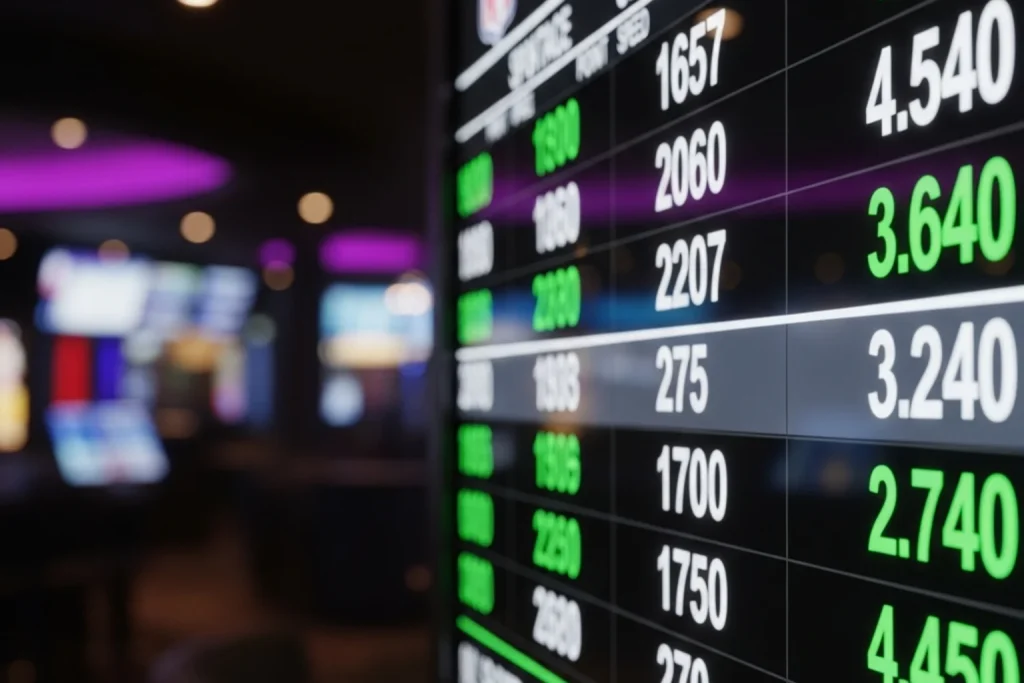
Tuesday evening, a game opens at Buffalo -3. By Wednesday morning it is Buffalo -3.5. Thursday it ticks to -4. Friday afternoon, with no injury news and no weather change, it snaps back to -3. I watched that sequence unfold last season and it told me more about the game than any statistical model could. The opening move said sharp money liked Buffalo. The Friday reversal said even sharper money disagreed. Understanding why lines move — and what different movement patterns signal — is one of the most valuable skills a UK punter can develop, because the line itself is a living, breathing summary of every opinion the market holds.
NFL lines are not static prices. They are dynamic markets that respond to betting volume, new information, and the strategic behaviour of both recreational and professional bettors. Between the moment a line opens on Tuesday and the moment it closes at kickoff on Sunday, it absorbs thousands of bets, multiple injury reports, weather updates, and the accumulated wisdom of the sharpest handicappers in the world. Learning to read that movement turns the line from a number you bet against into a source of information you bet with.
See also home field advantage in rivalry matchups.
Contents
Why Lines Move: The Three Drivers
I spent my first two seasons thinking lines moved only because of injuries. A quarterback goes down, the line shifts — simple. Then I started tracking line movement on games with no injury news at all and discovered that spreads routinely moved one to two points between Tuesday and Sunday without a single roster change. The movement came from betting action, and understanding the distinction between the types of action that move lines changed how I approach every game.
The first driver is sharp money — bets placed by professional syndicates, respected individual bettors, and algorithmic models that the bookmaker has flagged as consistently profitable. Sharp bets move lines even when they represent a small fraction of total tickets, because bookmakers respect the source. A single sharp bet of ten thousand pounds on one side of a spread can move the line more than a hundred recreational bets of fifty pounds on the other side. The bookmaker is not balancing their book by ticket count; they are balancing it by credibility-weighted exposure.
The second driver is public money — the aggregate weight of recreational betting volume. Public money tends to favour favourites, overs, and teams with strong media narratives. When enough public money piles onto one side, the bookmaker adjusts the line to attract action on the other side and balance their risk. Public-driven line movement is typically slower and more gradual than sharp-driven movement, and it often pushes lines away from fair value rather than toward it.
The third driver is information — injury reports, weather changes, roster moves, and any other news that affects the expected outcome. Information-driven line movement is the most straightforward to interpret: a starting quarterback is ruled out and the spread adjusts by three to five points. The challenge is speed. In the American market, information-driven moves happen within minutes of the news breaking. UK bookmakers often lag by 30 minutes to several hours, creating windows for alert punters to act on information before the price adjusts.
Reverse Line Movement: The Sharpest Signal
The most powerful pattern I track is reverse line movement — when the line moves in the opposite direction to the majority of public bets. If 72 percent of spread bets are on Team A but the line moves from Team A -3 to Team A -2.5, something is happening beneath the surface. The public wants Team A, but the bookmaker is making Team B more attractive. That means sharp money — likely a smaller number of high-credibility, high-volume bets — is on Team B, and the bookmaker trusts those bettors more than the crowd.
Reverse line movement is not infallible. It identifies where respected money is positioned, but respected money loses roughly 45 percent of the time. The edge is marginal, not absolute. Over a full season, though, siding with reverse line movement on NFL spreads has produced a cover rate above 53 percent in my tracking — enough to be profitable at standard UK odds and significantly better than randomly picking sides.
I look for reverse line movement primarily on Tuesday and Wednesday, when the early-week sharp action is most visible. By Thursday, the picture becomes muddier as public volume increases and additional information enters the market. The cleanest RLM signals occur in the first 48 hours after a line opens, before the noise of public opinion obscures the sharp signal.
Steam Moves and Market Corrections
A steam move is a rapid, coordinated line shift across multiple sportsbooks simultaneously. It happens when a professional syndicate places large bets at several operators within a short window, forcing all of them to adjust at once. Steam moves are the market’s equivalent of a fire alarm — everything shifts quickly and decisively.
From a UK perspective, steam moves originate in the American market and ripple outward. If five major US sportsbooks move a spread from -3 to -4 within ten minutes on a Wednesday afternoon (early evening UK time), UK operators will follow within the hour. The delay creates a brief window where the UK line has not yet caught up to the American move, and punters who monitor both markets can capture that gap.
I use a free odds-tracking site that displays real-time lines from major American and UK operators side by side. When I see a steam move in the US market, I immediately check whether my UK bookmakers have adjusted. If they have not, and the move aligns with my own analysis, I place the bet before the adjustment arrives. This approach requires vigilance during American market hours (roughly 3 pm to midnight UK time on weekdays) but has been one of my most consistent sources of positive closing line value.
Not every sharp move is a steam move. A single sharp bet at one operator might move that line without triggering a market-wide adjustment. These isolated moves are less reliable signals because they reflect one opinion rather than a coordinated consensus. I only act on moves that appear across at least three operators within a tight time window.
Trap Lines and False Signals
The global sports betting market is projected to reach roughly $88 billion in 2026, and the NFL captures a disproportionate share of that volume. With so much money flowing through the market, not every line movement carries genuine information. Some moves are noise, and distinguishing signal from noise is what separates experienced handicappers from bettors who chase every shift.
Trap lines are numbers that look too good to be true — and usually are. If a strong team opens as a 3-point favourite and the line drifts to -1.5 by Wednesday despite no negative news, the market may be baiting public money onto the favourite at a better number. When the line snaps back to -3 or beyond by kickoff, anyone who bet at -1.5 captured value, but anyone who waited has lost the opportunity. The challenge is that some of these drifts are genuine and reflect sharp money on the other side. I treat any unexplained drift of two or more points as a warning sign that requires additional investigation before I commit money.
Another false signal is late movement driven by recreational parlays. On Sunday morning, a wave of accumulator bets can push a spread half a point in one direction simply because the game is included in a high volume of multi-leg bets. This movement reflects betting structure rather than game analysis, and it typically corrects by kickoff. I ignore sub-half-point movements that occur within two hours of kickoff unless they coincide with late-breaking news.
See also nfl sport betting for the complete NFL betting guide.
Using Line Movement in Your Weekly Process
Line movement is a supplement to handicapping, not a replacement for it. I start every week with my own projected spread for each game, derived from power ratings, matchup analysis, and situational factors. Only after I have formed an independent opinion do I check what the market is doing. This sequence matters — if you look at the line first and then build your analysis, you unconsciously anchor to the market’s number and lose the ability to identify when it is wrong.
Once I have my projections, I overlay the opening line and note the gap. Then I monitor line movement through the week, recording the direction, magnitude, and timing of each shift. By Friday, I have a complete picture: my projection, the opening line, the current line, and the movement path between them. Games where my projection and the line movement agree — I think Team A should be favoured by more, and the line is moving in that direction — are my highest-conviction bets. Games where my projection and the line movement disagree require a harder look: either my analysis missed something the sharp money sees, or the market is reacting to factors I have already accounted for differently.
The practical application for UK punters is straightforward. Open accounts at three or four UK-licensed operators. Check lines on Tuesday when they open. Record the opening numbers. Monitor movement through the week using an odds comparison site. Bet early when you have strong conviction and the line has not yet moved toward your position. Wait until Friday if your conviction depends on information not yet available (injury reports, weather). And never chase a line that has already moved past your projected value — if you missed the window, let the game go and focus on the next week’s slate. The handicapping fundamentals guide covers the full analytical process that precedes line movement analysis, including power ratings and matchup breakdowns.
