
NFL Handicapping Basics: A UK Punter’s Guide to Analysing Games
 Available in US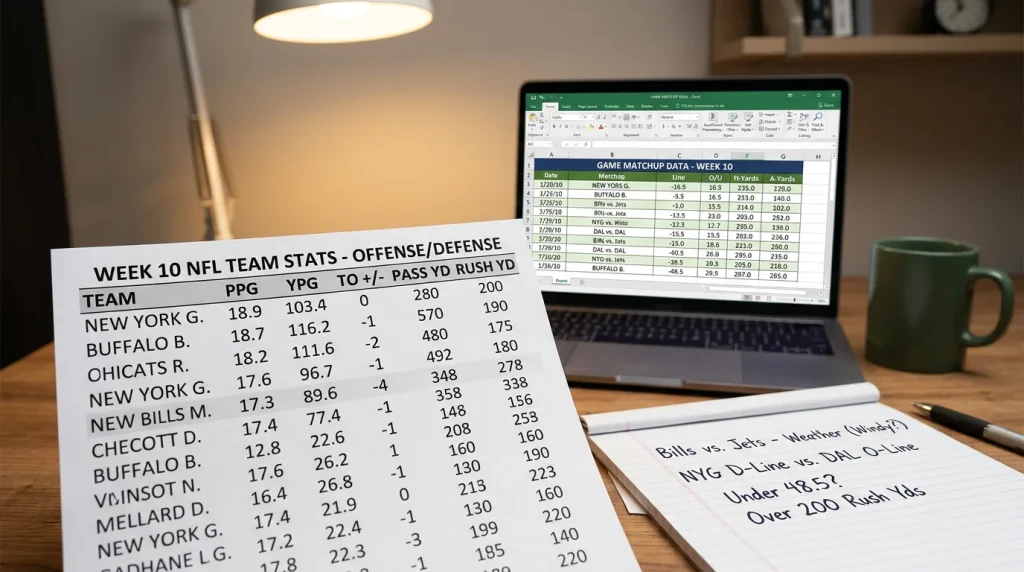
The first time someone used the word “handicapping” in front of me, I thought they were talking about golf. In American sports betting, handicapping means something entirely different — it is the process of analysing a game to determine which side has value against the posted line. I spent my first two NFL seasons picking games based on which team I thought would win, without any consideration of the spread or whether the price was right. My results were predictable: occasional lucky hits drowned in a sea of poorly priced bets. Learning to handicap — properly, systematically — turned my NFL betting from an expensive hobby into a structured pursuit with measurable results.
Handicapping is not about predicting winners. It is about identifying when the bookmaker’s line does not accurately reflect the true probability of an outcome. A team can be terrible and still be the right side of a bet if the spread has overcorrected. A team can be brilliant and still be the wrong side if the public has pushed the line too far in their favour. That distinction is the foundation of everything in this piece.
See also NFL division rivalries and scheduling impact.
Contents
Power Ratings: Your Starting Point
Every handicapper I respect starts with power ratings — a numerical ranking of each NFL team’s strength that allows you to project a point spread for any matchup. The concept is simple: if you rate Team A as an 85 and Team B as a 78, the projected spread is Team A by 7, adjusted for home-field advantage. Comparing your projected spread to the bookmaker’s listed spread reveals whether value exists on either side.
Building your own power ratings requires a choice about methodology. Some handicappers use purely statistical models — win probability, yards per play, DVOA (Defence-adjusted Value Over Average), or EPA (Expected Points Added). Others use subjective assessments based on film study and roster evaluation. I use a hybrid: a statistical baseline adjusted by subjective factors that the numbers do not capture well, such as coaching quality, locker-room dynamics, and scheme changes.
The statistical baseline gives me objectivity. My subjective adjustments give me flexibility. When both agree — the numbers say Team A is undervalued and my film review confirms they are playing well — I have a high-conviction bet. When they disagree, I either dig deeper or pass on the game entirely. The worst handicapping outcomes I have experienced came from overruling my numbers with a gut feeling that turned out to be narrative-driven rather than evidence-based.
I update my power ratings after every week of games. The update process matters as much as the initial ratings: how much weight do you give to the most recent result versus the full season’s body of work? I use a decay factor that weights recent games more heavily but never discards early-season data entirely. A team’s Week 14 performance is more indicative of their current ability than their Week 2 performance, but discarding Week 2 altogether sacrifices sample size in a sport with very few data points.
Situational Factors the Market Underprices
Last season I noticed something that confirmed years of tracking: teams playing their third consecutive road game covered the spread at a rate above 55 percent. The market had underpriced the fatigue and routine-disruption factor. These situational angles are the bread and butter of handicapping, because they represent systematic patterns that the line does not fully absorb.
Rest advantages are the most well-documented situational factor. A team coming off a bye week has an extra week of preparation, injury recovery, and strategic planning. Historically, teams coming off byes cover the spread at a rate close to 54 percent — a meaningful edge given that the breakeven rate at standard odds is approximately 52.4 percent. The market adjusts for byes, but in my experience the adjustment leaves one to two points of residual value on the rested side.
Short-week games — particularly Thursday Night Football — create the opposite dynamic. Teams travelling on short rest underperform relative to the spread, especially when the travel crosses time zones. I add a one-point adjustment to the home side in Thursday games as a baseline, with an additional half-point if the away team is travelling from a different time zone.
Revenge and letdown spots are harder to quantify but real. A team that suffered a humiliating blowout loss tends to perform above expectations the following week, driven by coaching adjustments and player motivation. A team that just won a massive emotional game (a division clincher, a rivalry blowout) sometimes performs below expectations the following week. These effects are small — half a point to a point — but they stack with other situational factors to create meaningful value when the market ignores them.
Matchup Analysis Beyond the Box Score
Power ratings tell you how good a team is overall. Matchup analysis tells you how specific strengths and weaknesses interact in a particular game. A team with a dominant rushing attack facing a defence that cannot stop the run will perform differently than the same team facing a defence that excels against the run but struggles against the pass. The matchup shapes the game in ways that team-level ratings alone cannot predict.
I focus my matchup analysis on three areas. First: offensive line versus defensive front. This matchup controls the running game and pass protection, which together determine whether an offence can execute its game plan. A mismatched offensive line — say, a team with weak interior linemen facing a defence with elite interior pass rushers — will produce more sacks, hurries, and negative plays than the team’s season averages suggest.
Second: secondary versus receiving corps. A defence with a lockdown corner can neutralise one receiver but might be vulnerable at the slot or against tight ends. Understanding which receivers the defence can cover and which they cannot shapes my passing yards and touchdown projections for the game.
Third: coaching tendencies. Some coaches are aggressive on fourth down, which affects drive-conversion rates and scoring. Others are conservative in the red zone, preferring field goals to risky passing plays. Coaching tendencies interact with matchup data in predictable ways — an aggressive coach facing a weak red zone defence will produce more touchdowns than the same coach facing a strong red zone unit. These tendencies are trackable and quantifiable over the course of a season.
See also nfl sport betting for the complete NFL betting guide.
Line Shopping and Market Timing
About 290 million online bets are placed monthly across the UK, and a meaningful share of NFL wagers are placed at whichever bookmaker the bettor happens to have open on their phone. That laziness costs money. Shopping for the best available line across multiple UK operators is the simplest, lowest-effort way to improve your NFL betting results, and it requires no analytical ability whatsoever.
NFL spreads at UK bookmakers are not identical. One operator might list a game at -3, while another has it at -2.5 on the same side. That half-point difference, applied across an entire season of bets, translates to a meaningful improvement in your cover rate. I maintain accounts at four UK-licensed operators and check all four before placing any spread or total bet. The five minutes it takes to compare prices is the highest-return activity in my entire betting process.
Timing matters as well. Lines are softest when they first open (typically Tuesday for most NFL games) and sharpen as the week progresses toward kickoff. Betting early captures the most closing line value, but it also means betting before the full week’s information (injury reports, weather updates) is available. My compromise: I place high-conviction bets on Tuesday or Wednesday and hold lower-conviction plays until Friday, when the injury picture is clearer. For games where I have no strong view, I do not bet at all — the discipline of passing is as important as the discipline of timing.
Putting It All Together: A Weekly Handicapping Routine
The best handicapping system in the world is useless without a consistent routine. I follow the same weekly process every week of the NFL season, and the structure itself has become one of my greatest edges — not because the process is secret or complex, but because consistency eliminates the emotional decision-making that derails most recreational bettors.
Monday and Tuesday: I update my power ratings with the previous week’s results, review any coaching changes or significant injuries, and generate projected spreads and totals for the upcoming slate. When opening lines appear on Tuesday, I compare them to my numbers and flag potential bets.
Wednesday and Thursday: I dig into matchup specifics for the flagged games. This is where I look at offensive line grades, defensive coverage tendencies, red zone data, and situational factors. By Thursday evening I have a shortlist of three to six games where my analysis diverges from the market by two or more points.
Friday: final injury reports arrive. I adjust my projections for any significant absences and check whether the line has moved toward my position (reducing the value) or stayed put (preserving it). Bets that still show value are confirmed. The closing line value guide explains how to measure whether your Tuesday and Wednesday bets are capturing genuine edge relative to the closing price — the most reliable diagnostic of handicapping quality.
Saturday and Sunday: I lock in remaining bets, confirm no late-breaking news has invalidated my analysis, and watch the games. Post-game, I record results and note any qualitative observations that my model missed — these notes feed into the following Monday’s power rating update and keep the system evolving throughout the season.
